
Quick answer: Keep the discharge line sloped and full size so it drains after every pump cycle, end it well away from the house, and give it a place to spill near the wall if the outside end ices up. If a frozen sump pump line has already stopped the water, warm it gently with electric heat or hot towels, never a flame, and call a licensed plumber if you can’t reach or thaw it.
This article is general information about protecting a sump pump discharge line in a New Jersey winter, as of November 2026. It is not plumbing, electrical or code advice for your home. Follow your pump maker’s instructions, check outlet rules with your township, and call a licensed plumber or electrician for repairs.
On this page
- What happens if my sump pump discharge pipe freezes?
- How cold does it get around West Caldwell, and how often?
- How deep is the frost line in northern New Jersey?
- How should a discharge line be routed so it drains between cycles?
- Where can the water go when it’s freezing outside?
- Do freeze relief fittings and heat cable help?
- How do you thaw a frozen sump pump line?
- Frequently asked questions
- Want the discharge line checked before the deep cold?
- About ARD Waterproofing
- Sources
This guide from ARD Waterproofing starts with the cold itself: how often it freezes here and how deep the ground can freeze in northern New Jersey. ARD handles sump pump installation and discharge routing from its West Caldwell base.
From there it covers how a line should be routed, where the water can go in winter, what freeze protection adds, and how to thaw a line that’s already frozen.
What happens if my sump pump discharge pipe freezes?
The pump loses its way out. Water expands as it freezes, and once ice blocks the line, the pump can keep running against a pipe that can’t carry water away. When a pump runs but delivers little or no water, one pump maker’s troubleshooting guide says to check the discharge pipe, and meanwhile the pit can fill and overflow.
The American Red Cross explains that this expansion puts tremendous pressure on whatever holds the water, metal or plastic pipe included. A frozen line isn’t only blocked; it can crack.
A blocked line is one way a pump gets stopped in winter. A power cut is another, and our guide to keeping a sump pump running during a power outage covers the backup options.
If water has already come up over the pit, start with what to do in the first hours of a flooded basement.
How cold does it get around West Caldwell, and how often?
Cold enough to matter most of the winter. NOAA’s 1991 to 2020 climate normals for the Caldwell Essex Co AP weather station, which this guide uses for West Caldwell, average about 108 nights a year at or below 32°F and about 33 at or below 20°F. January’s normal low is 22.9°F.
Most of those nights fall between November and March.
| Month | Average nights at or below 32°F | Average nights at or below 20°F |
|---|---|---|
| November | 11.9 | 0.7 |
| December | 23.2 | 6.3 |
| January | 25.7 | 13.6 |
| February | 23.8 | 9.2 |
| March | 17.6 | 2.8 |
The same station averages about 7 nights a year at 10°F or colder, most of them in January and February.
These are long-run averages, not a forecast for this winter. They show how many freezing nights an outdoor discharge line in this part of Essex County is built to get through.
How deep is the frost line in northern New Jersey?
New Jersey’s residential building code lists a frost line depth of 3 feet for northern New Jersey and 2 feet 6 inches for southern New Jersey. Essex County is in the northern zone, which the code defines as Mercer and Middlesex Counties and all the counties north of them.
That figure sits in the code’s table of climatic and geographic design criteria. It’s a way to picture how deep the ground can freeze here, not a rule about how deep a sump discharge line has to be buried.
It’s also deeper than some figures you’ll find online. One online guide written for the Washington, D.C. area gives 20 to 30 inches, which doesn’t fit northern New Jersey.
So burying a whole discharge line below the frost line is a big dig. Before any trenching, New Jersey’s underground facility rules require notice to New Jersey One Call at 811, and that applies to homeowners digging on their own property too.
How should a discharge line be routed so it drains between cycles?
With a steady fall from where it leaves the house to where it ends, so water runs out after every cycle instead of sitting in the pipe. A sag or an uphill section holds water, and water left standing in a pipe can freeze. Keep the pipe full size all the way to the outlet, too.
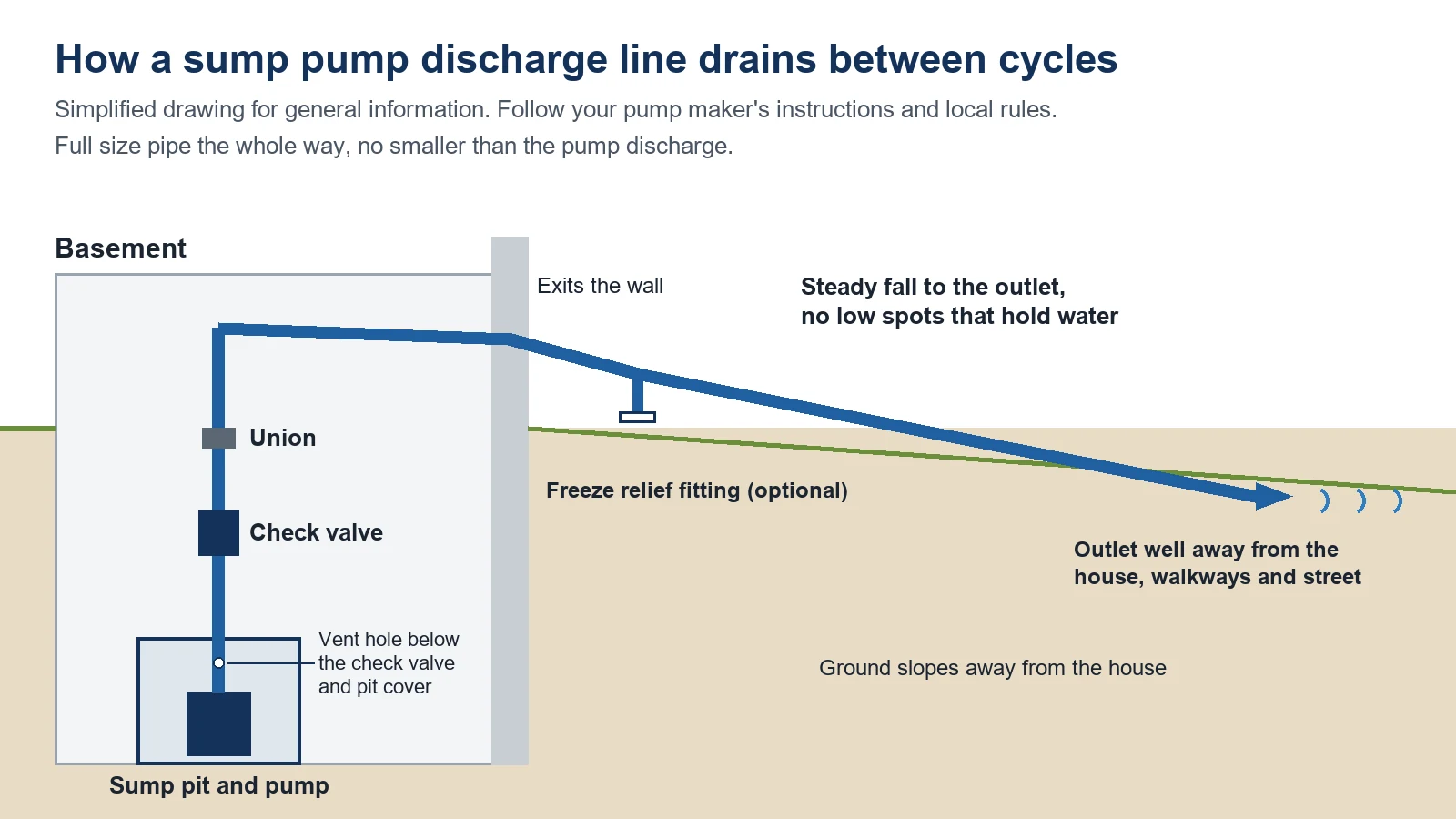
Zoeller’s installation instructions for its Model 63 and 95 sump pumps set out a few related points:
- Don’t use a discharge pipe smaller than the pump discharge.
- Install a check valve and a union in the discharge line.
- With a check valve, drill a vent hole of about 3/16 inch in the discharge pipe below the check valve and pit cover, and check it now and then for clogging.
- Inspect and test the system at least every 3 months.
Your own pump’s manual may differ, so follow the one that came with it.
Pipe length and elbows affect flow as well. Our post on how a sump pump system is sized and routed goes into that side of it.
Where can the water go when it’s freezing outside?
Out to a spot where it can spread and soak in, away from your foundation and walkways, and not onto the street or a neighbor’s yard. Water that runs across paving in January can turn to ice. Some towns also put in writing where sump water may and may not go, so check yours before you move an outlet.
Verona is one example. Its engineering office says sump pump discharge onto the public roadway through the curb “creates hazardous icing conditions during the winter and therefore is not permitted.” It also says surface discharge “must not be directly pointed towards the adjoining properties.”
The same guidance lets an existing curb discharge stay until the street is fully reconstructed. Other towns set their own rules, so ask your township’s engineering office.
If the ground around your outlet already stays soggy, it helps to work out what’s behind your yard drainage problem first.
Do freeze relief fittings and heat cable help?
They can, as a backup to good routing. Sump pump discharge freeze protection usually means a freeze relief fitting near the house, which gives water a second way out if the far end of the line ices over, and sometimes heat cable. Neither one makes up for a line that holds water between cycles.
A relief fitting lets water spill out next to the house when the main line is blocked. Put it where that overflow drains away from the foundation and won’t sheet across a walkway.
For heat cable, the American Red Cross points homeowners to UL-listed “heat tape” or “heat cable” on exposed water pipes. That advice is written for water supply pipes, so check that any cable you consider is made for the pipe and the outdoor spot you have in mind, and follow its maker’s instructions.
Any new outlet or wiring near a sump belongs with a licensed electrician. Zoeller’s instructions say its pumps must be installed in accordance with the National Electrical Code and all applicable local codes and ordinances.
How do you thaw a frozen sump pump line?
Find the frozen section, then warm it gently with electric heat or hot towels, never a flame. For frozen pipes, the American Red Cross lists an electric heating pad, an electric hair dryer, a portable space heater kept away from flammable materials, or towels soaked in hot water, and says not to use a blowtorch or any other open flame.
That advice is written for water supply pipes, and the same caution about open flame makes sense for a drain line.
Keep heaters and cords away from the sump pit and any standing water.
The Red Cross also says to call a licensed plumber if you can’t find the frozen area, can’t reach it, or can’t thaw it. A section that’s buried or runs inside a wall often falls in that group.
Our post on who’s allowed to work on sump pump plumbing in New Jersey explains the licensing side.
Frequently asked questions
How long do pipes have to be frozen before they burst?
There’s no set number of hours. It depends on how hard and how long it freezes and on whether water is trapped inside the pipe. A discharge line that drains fully between cycles has less water in it to freeze, which is one more reason the slope matters. If a pipe has already split, call a licensed plumber.
Want the discharge line checked before the deep cold?
ARD Waterproofing installs and replaces sump pumps from its base in West Caldwell for homes across West Essex, Passaic and Morris County. On its installs, the company says, the check valve is installed to prevent backflow and the discharge line is sealed and routed. To have your line looked at before January, contact ARD Waterproofing.
About ARD Waterproofing
ARD Waterproofing is a residential waterproofing company at 98 Smull Ave in West Caldwell, New Jersey, owned by David Roth. It’s registered as a New Jersey Home Improvement Contractor, registration number 13VH12460700.
Sources
- NOAA National Centers for Environmental Information, U.S. Climate Normals 1991 to 2020, monthly normals for station Caldwell Essex Co AP, NJ (USW00054743), accessed November 2026
- N.J.A.C. 5:23-3.21, one- and two-family dwelling subcode, amendments to Table R301.2, Climatic and Geographic Design Criteria, NJ Department of Community Affairs, accessed November 2026
- N.J.A.C. 14:2-3.1, Underground Facility Protection, New Jersey One Call, accessed November 2026
- Township of Verona, Engineering, Roof Leaders, Sump Pump Discharge, Grading and Property Maintenance Guidelines, accessed November 2026
- American Red Cross, Frozen Pipes, accessed November 2026
- Zoeller, installation instructions FM2895 for Models 63 and 95 sump pumps, accessed November 2026
 Do I Need a Permit to Install an Egress Window in West Caldwell, NJ?