
Quick Summary
- Not every wet yard is the same problem — surface water and subsurface hydrostatic pressure require completely different fixes.
- A puddle that disappears within 12–24 hours is usually a grading issue, not a foundation threat. Water that lingers 48+ hours is the one to take seriously.
- NJ’s clay-heavy soil (especially in Essex, Passaic, and Morris Counties) makes accurate diagnosis more important — and more difficult — than in most other regions.
After a hard rain, a lot of NJ homeowners are staring at the same thing: a puddle that won’t go away. The question isn’t whether to fix it. It’s whether you’re fixing the right thing.
That distinction matters more than most people realize. Surface water and subsurface hydrostatic pressure look similar from your back door — standing water, a soggy yard, maybe a damp smell coming up from the basement. But they’re caused by different forces, they threaten your home in different ways, and they require completely different solutions. Treating the wrong one doesn’t just waste money. It leaves the actual problem untouched.
You’re right to pay attention to this. Here’s how we tell the difference — and how you can start to read the signs yourself.
What’s Actually Happening Under Your Yard After a Storm
Surface water — what it looks like and where it comes from
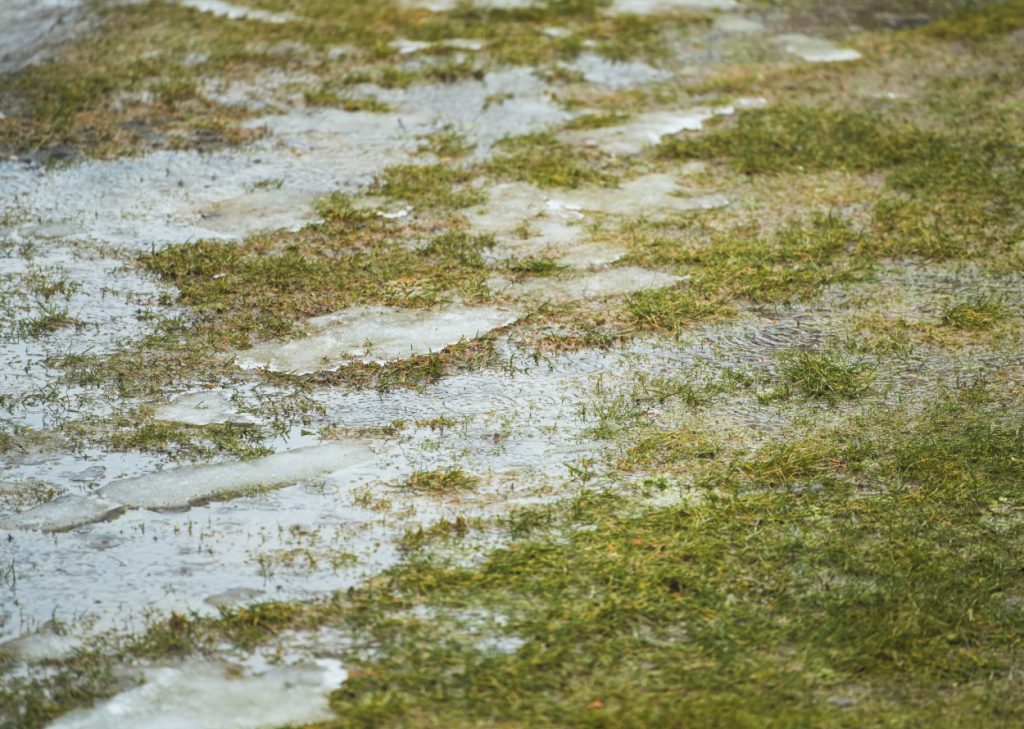
Surface water is exactly what it sounds like: rainwater that lands on your yard, can’t drain fast enough, and sits on top of the soil. You’ll see it pooling in low spots, collecting near downspout exits, or spreading across flat areas that don’t have enough slope to move water away from the house.
The good news about surface water: it’s visible, it’s predictable, and it usually responds well to targeted fixes — regrading, channel drains, or surface catch basins and channel drains positioned to intercept the flow before it reaches your foundation.
Subsurface saturation — the water you can’t see
Subsurface water is the one that keeps contractors honest. This is water that has soaked down through the soil, saturated the ground around your foundation, and is now pressing against your basement or crawl space walls from the outside. You can’t see it from the yard. By the time you notice it inside — a damp wall, a musty smell, a sump pump that won’t stop running — it’s already been building for hours or days.
This is what waterproofing professionals call hydrostatic pressure: the force that saturated soil exerts against a foundation wall. It’s not dramatic. It’s slow, steady, and if it goes unaddressed long enough, it works its way through block, stone, or poured concrete.
The Diagnostic Signs We Look For (And You Can Too)
How do I know if my yard drainage problem is surface water or underground water?
The single most useful diagnostic tool you have right now is a clock.
Signs it’s likely a surface issue:
- Water pools in the yard but disappears within 12–24 hours after rain stops
- Pooling is concentrated in obvious low spots or near downspout discharge
- No corresponding symptoms inside — basement walls are dry, no musty odor
- The problem only appears during heavy rain, not after moderate storms
Signs it’s likely a subsurface or pressure issue:
- Water is still sitting in the yard 48 hours or more after rain
- Damp or wet spots on basement walls, especially at the base or along mortar joints
- A musty smell that gets worse after storms
- Sump pump running constantly or cycling more than usual
- Efflorescence (white chalky deposits) on foundation walls — a sign water has been pushing through
| What You’re Seeing | Likely Cause |
| Puddle gone within 12–24 hrs | Surface drainage / grading issue |
| Water still present at 48+ hrs | Subsurface saturation |
| Pooling only near downspouts | Surface runoff, discharge management |
| Damp basement walls after rain | Hydrostatic pressure |
| Musty smell, sump running constantly | Subsurface saturation / pressure |
| White deposits on foundation walls | Chronic water intrusion through masonry |
Why Hydrostatic Pressure Is the One You Can’t Ignore
What causes hydrostatic pressure against a foundation?
When soil around a foundation becomes fully saturated, it stops absorbing water and starts holding it. That standing water has weight and pressure behind it — and your foundation wall is the only thing in its way.
Over time, that pressure finds the path of least resistance: hairline cracks, mortar joints, the gap where your foundation meets the footing. Left alone, it widens those openings. Water intrusion follows. In serious cases, you start to see inward bowing on block walls — a sign that the pressure has been working for a long time.
Here’s the NJ-specific factor that most generic articles miss entirely: Essex, Passaic, and Morris County homes are largely built on clay-dominant soil. Clay absorbs water slowly and releases it even more slowly. After a significant storm, clay soil doesn’t drain —it holds. That means the saturation window around your foundation can last days, not hours, and the hydrostatic pressure is drainage/grading rather than temporary.
This is why a yard that “drains fine” in other parts of the country can be a chronic problem in Verona or Montclair. The soil composition here changes the math.
New Jersey averages over 46 inches of rain annually; saturation/pressurizing storm events hit clay-heavy soil hard. This isn’t a once-in-a-decade problem. It’s a structural reality for a lot of NJ homeowners, and it demands a proper diagnosis — not a one-size fix.
The Most Common Misdiagnosis We See in NJ Yards
We recently walked a property in West Caldwell where the homeowner had already gotten two quotes. Both contractors recommended a catch basin in the corner of the yard where water was pooling. It seemed logical — there was clearly a drainage problem, and a catch basin would collect the standing water.
The issue: the water wasn’t pooling because it had nowhere to go on the surface. It was pooling because the soil 18 inches down was fully saturated and had nowhere to drain. Installing a surface catch basin there would have collected some rainwater. It would have done nothing for the subsurface saturation pressing against the foundation wall on the other side of the house.
This is what we call the “catch basin reflex” — the instinct to treat visible water with a visible solution. It’s not always wrong. But when the real problem is underground, it leaves the actual threat untouched while giving the homeowner a false sense that something was fixed.
A proper property walkthrough changes everything. When we walk a site, we’re not just looking at where the water is sitting. We’re looking at soil type, grade, the age and construction of the foundation, where the water is coming from before it reaches that low spot, and whether there are any signs of subsurface pressure inside the home. That 15-minute walk is what separates a solution that works from one that looks good on paper.
Not sure which problem you’re dealing with? That’s exactly what our free property walkthrough is for. We walk the site, read the root cause, and tell you what you actually need — nothing more. Schedule a free property walkthrough and we’ll give you a straight answer.
Which Solution Matches Which Problem
Do I need a French drain or a catch basin?
The answer depends entirely on where the water is coming from.
If it’s a surface issue:
- A catch basin or channel drain intercepts runoff before it pools
- Regrading the yard to direct water away from the foundation
- Downspout extensions or underground discharge lines
If it’s a subsurface / pressure issue:
- An exterior French drain system installed around the foundation perimeter intercepts groundwater before it reaches the wall
- Interior drainage solutions for basement water manage water that’s already entered the foundation system
- Sump pump installation provides active pressure relief, moving water out before it builds
When you need both: Some properties have genuine surface and subsurface problems — especially older homes in Montclair or Parsippany where original grading has settled over decades. In those cases, the sequence matters: address the subsurface pressure first, then manage the surface flow. Doing it in reverse order doesn’t protect the foundation.
What to Expect From a Proper Diagnosis
When we come out to walk a property, there’s no sales pitch waiting at the end of it. We look at the yard, we look at the foundation, we look inside the basement for any symptoms there, and we tell you what we see.
If it’s a grading issue that a landscaper can fix for a few hundred dollars, we’ll tell you that. If it’s a surface drainage problem that needs a catch basin, we’ll tell you that too. And if we see signs of subsurface saturation that’s threatening your foundation, we’ll explain exactly what we’re looking at and what a permanentsubsurface/pressure the USDA’s own guidance on surface vs. subsurface water management —the distinction is technical and consequential. It’s also why a 15-minute property walk by someone who does management every day is worth more than an hour of Googling.
ARD is a licensed NJ waterproofing contractor (License #13VH12460700) with a 5.0 rating across 111+ reviews. The owner is on-site for every evaluation — not a sales rep, not a subcontractor. We’ve been working in West Essex, Passaic, and Morris Counties since 2015, and we know the soil, the storm patterns, and the foundation types in this area.
The Right Fix Starts With the Right Diagnosis
A puddle in your yard after a storm might be nothing. It might be a grading fix that costs a few hundred dollars. Or it might be the visible sign of a subsurface problem that’s been quietly working against your foundation for years.
The only way to know is to look at it properly. Not to assume. Not to default to the most common solution. And not to let anyone sell you a fix before they’ve actually diagnosed what’s wrong.
That’s what we do. And we’re happy to walk your property and give you a straight answer — no pressure, no upsell.
Call or Text ARD Waterproofing
📞 (201) 646-5936 — Available 24/7
We’ll schedule a free property walkthrough, walk the site with you, and tell you exactly what we see. If you need work done, we’ll give you a fair, all-inclusive quote. If you don’t, we’ll tell you that too.
ARD Waterproofing — West Caldwell, NJ | License #13VH12460700 | 5.0 Stars | Serving West Essex, Passaic & Morris Counties
Frequently Asked Questions
How long should water sit in my yard before I’m concerned?
As a general rule, surface water that drains within 12–24 hours after rain stops is typically a grading or surface drainage issue — worth monitoring, but not an immediate foundation threat. Water that’s still present at 48 hours or beyond suggests the soil is saturated and not releasing water, which can create hydrostatic pressure against your foundation. That’s the threshold where a professional evaluation makes sense.
Can a puddle in my yard damage my foundation?
A puddle on its own won’t damage your foundation. The risk is what’s happening underground: when soil around a foundation becomes fully saturated, it exerts hydrostatic pressure against the wall. Over time, that pressure can force water through cracks, mortar joints, and construction gaps — leading to water intrusion, efflorescence, and in serious cases, structural movement. The puddle is often a symptom of that saturation, not the cause of the damage.
What is the difference between a French drain and a catch basin?
A catch basin is a surface solution — it collects runoff water from the yard or hardscape and routes it away through an underground pipe. A French drain is a subsurface solution — it’s a perforated pipe installed in a gravel-filled trench that intercepts groundwater moving through the soil before it reaches your foundation. If your problem is surface pooling, a catch basin may be the right fix. If your problem is subsurface saturation or hydrostatic pressure, you need a French drain. Installing the wrong one doesn’t solve the problem.
 Hydrostatic Pressure: Why Saturated Soil Is Bowing Your Basement Walls (And How to Relieve It)