

Quick Summary
- Basement leaks in North Jersey are driven by hydrostatic pressure from clay-heavy glacial soils — not foundation failure or bad original construction.
- Most North Jersey homes can be permanently protected with an interior drainage system installed in a single day. Exterior excavation is the exception, not the default.
- The difference between a $4,000 and a $14,000 quote for “the same job” almost always comes down to methodology — this guide shows you exactly what to look for before you sign anything.
If you’re reading this, water has already shown up in your basement. Maybe it’s the same corner every time it rains hard. Maybe it’s a musty smell that won’t quit, no matter how many times you run the dehumidifier. Maybe you’ve already had it “fixed” — and it came back.
You’re not imagining things, and you didn’t buy a bad house. What you have is a geology problem. Basements in North Jersey leak primarily because of hydrostatic pressure — groundwater pressing outward against your foundation walls from saturated, clay-heavy soil. That pressure doesn’t care how well your house was built or how old it is. The good news: most homes in West Caldwell, Montclair, Morristown, and the surrounding communities can be permanently solved with a properly designed drainage system, often in a single day.
This guide explains exactly why the problem happens, which solutions actually match which problems, and how to vet a basement waterproofing contractor without getting burned — before you spend a dollar.
Why Basements Leak in North Jersey (It’s Not Bad Luck)
What Clay Soil and High Water Tables Do to Your Foundation
North Jersey sits on glacially deposited clay-loam soils — a legacy of the last ice age that makes this region uniquely challenging for foundation waterproofing. Unlike sandy or loamy soils that drain quickly after a storm, clay holds water. It expands when saturated, contracts during a dry stretch, then expands again the next time it rains. That cycle — repeated season after season, accelerated by North Jersey’s freeze-thaw winters — creates constant lateral pressure against your foundation walls.
The Passaic River watershed runs directly through Essex and Passaic Counties. According to the NJ Department of Environmental Protection, significant portions of these neighborhoods sit within or adjacent to flood hazard areas — not because of surface flooding, but because the water table in these zones rises more aggressively after sustained rainfall than it does in higher-elevation or sandy-soil regions further south or west. After a fast-moving Northeast storm drops two inches of rain on ground that’s already saturated from the week before, that water has nowhere to go. It presses against your block or poured concrete foundation from every direction.
This is hydrostatic pressure. And it will find the path of least resistance every time.
The Floor-Wall Joint: Why Water Always Shows Up in the Same Place
“It comes in right where the floor meets the wall.”
We hear this from nearly every homeowner we meet in Essex and Passaic County. It’s not a coincidence. The joint between your basement floor slab and your foundation wall is a structural seam — and it’s where hydrostatic pressure most easily forces water through. The floor slab was poured separately from the wall, which means there’s always a slight gap there, even in well-constructed homes. As pressure builds outside the wall, water migrates down, finds that joint, and comes through.
This is why hydraulic cement and waterproof paint rarely hold. They address the surface where you see the water, not the pressure driving it there.
Damp Proofing vs. Waterproofing — Why That Black Tar Coating Isn’t Enough
Most North Jersey homes built before the 1990s had a damp proofing application — that black, tar-like coating applied to the exterior of the foundation wall during original construction. It is not the same thing as waterproofing, and the distinction matters more than most homeowners realize.
| Damp Proofing | Waterproofing | |
| What it is | Asphalt-based coating on exterior wall | Active drainage system managing hydrostatic pressure |
| What it handles | Soil moisture vapor | Water under sustained pressure |
| How long it lasts | 5–15 years before cracking | Permanent when properly installed |
| Cost range | Lower upfront | $5,000–$15,000+ depending on scope |
| When it’s used | New construction code minimum | When active water intrusion is the problem |
When a homeowner tells us they “had it waterproofed years ago” and the water came back, nine times out of ten, what they had was damp proofing — or a surface patch like hydraulic cement over a visible crack. Those approaches don’t relieve the pressure. They redirect it until it finds a new entry point.
Interior vs. Exterior Waterproofing — Which One Does Your Home Actually Need?
This is the question that drives the widest range in quotes — and the one where the most homeowners get steered in the wrong direction.
When Interior Routing Is the Smart, Permanent Choice
Interior waterproofing — specifically a sub-floor perimeter drainage system, commonly called an interior French drain — is the right solution for the vast majority of North Jersey homes dealing with hydrostatic seepage.
Here’s the key: the goal isn’t to stop water from pressing against your foundation. You can’t do that. The goal is to intercept that water before it reaches your living space, route it to a sump pump basin, and discharge it safely away from the home. A properly designed interior drainage system accomplishes this without excavating your yard, without disrupting your landscaping, and — in most cases — without a multi-day project.
Interior systems work permanently because they address the mechanism: pressure-driven water entering at the floor-wall joint. A correctly installed perimeter channel intercepts water at its entry point and removes it before it can pool or spread.
When Exterior Excavation Is Actually Necessary
Let’s be direct about this: exterior excavation is sometimes the right call. If your foundation wall has significant structural damage — not hairline seepage cracks, but actual bowing, separation, or major block cracking — the wall may need to be accessed and repaired from the outside before any drainage system is installed. If an exterior waterproofing membrane has failed and is allowing bulk water directly into the block cores, excavation addresses it at the source.
But exterior excavation should be recommended because the diagnostic evidence supports it — not as a default upsell. If a contractor quotes you for exterior work and you have a standard seepage-at-the-joint situation with an intact wall, ask them to walk you through specifically why an interior system won’t solve your problem. A contractor who knows what they’re doing will welcome that question.
The Role of Sump Pumps and Battery Backups in a Complete System
An interior drainage system without a correctly sized sump pump is a collection channel with nowhere to drain. The system collects the water, and the pump removes it.
Sizing matters more than most homeowners realize. A pump that’s undersized for your basement’s water volume and your area’s rainfall intensity will run continuously during a major storm event and can fail from overwork. For most homes in the West Caldwell, Verona, and Cedar Grove corridor, a primary pump rated at a minimum 1/3 horsepower with a cast iron housing is the right starting point — paired with a battery backup.
The battery backup is the piece people skip and the piece they regret skipping. Power outages in North Jersey frequently coincide with the exact storm events that put the most pressure on the ground. A backup unit with 8–12 hours of run time keeps your system operational through the storm that knocked out your power.
What to Expect During Installation — A Day in Your Basement
One of the most common questions we hear before a job: “How long is my basement going to be torn up?”
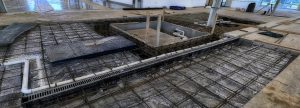
For most interior French drain installations in a standard residential basement, the answer is one day. The perimeter of the slab is broken along the floor-wall joint, the drainage channel and basin are installed, the sump pump is tied in, and the concrete is patched — typically within a single workday. When we leave, your basement is sealed, functional, and clean.
“Clean” isn’t a throwaway word here. We hear it in nearly every review we receive — not because we announce it, but because homeowners are genuinely surprised by it. Concrete work in a finished space is inherently dusty and disruptive. The work area is sealed off, dust containment is used throughout the job, and the site is cleaned completely before we leave. You don’t inherit the mess.

Not sure whether your situation calls for interior drainage or something more involved?
Schedule a free on-site inspection with our owner — not a sales rep, not a subcontracted crew. He’ll walk your basement, identify exactly where water is entering, and tell you what the right solution is. If interior drainage solves it, that’s what you’ll hear.
[Schedule a free basement inspection in West Caldwell →]
How to Read a Waterproofing Quote Without Getting Burned
This is the section we wish every homeowner would read before calling anyone.
Quotes in this industry vary dramatically because there is no standard methodology. A $4,000 quote and a $14,000 quote for a “wet basement” can reflect genuinely different scopes of work — or one of them can include work you don’t need. Here’s how to tell the difference.
What a legitimate waterproofing quote should include:
- A specific diagnosis of how water is entering — floor-wall joint seepage, wall crack infiltration, and window well overflow are different problems that require different solutions
- A clear explanation of the proposed solution and why it matches the diagnosis
- All materials and labor in the number — no “additional costs may apply” language for standard installation conditions
- A written warranty with explicit terms: what it covers, for how long, and whether it transfers at resale
Red flags worth walking away from:
- A recommendation for exterior excavation when the contractor hasn’t explained in plain terms why interior drainage won’t work
- Any quote delivered without a site visit or written scope
- Warranty terms that require annual service contracts to stay valid
- Pressure to sign the same day
A contractor who does the job right has no reason to oversell. Ask directly: “Is there any reason an interior French drain wouldn’t permanently solve this?” The quality of that answer tells you most of what you need to know.
How Long Does Basement Waterproofing Last? (And What a Good Warranty Covers)
A properly installed interior drainage system — correctly sized sump pump, properly sloped channel, solid perimeter installation — is designed to last the life of your home. The drainage channel itself doesn’t degrade. Water doesn’t overwhelm a correctly sized system under normal conditions.
What does change over time is the sump pump. Quality pumps are rated for 10–15 years of regular use. An annual inspection of the float switch and a test of the backup battery keep the system running as intended.
The warranty is where contractors separate themselves. ARD backs every installation with a lifetime transferable warranty — which means when you sell your home, the warranty transfers to the new owner. That directly addresses one of the most practical concerns we hear from homeowners in this market: “Is this going to affect my resale value?” A basement with documented, lifetime-warrantied waterproofing from a licensed NJ contractor is a selling point. It’s not a disclosure problem — it’s proof that the problem was solved properly.
Your Roadmap to a Permanent Fix
Here’s the sequence that gets you from “I have water in my basement” to a dry, protected home without overspending or getting burned:
- Understand the cause. Water at the floor-wall joint in clay-soil country is hydrostatic pressure — not a construction defect, not something that will stabilize on its own.
- Match the solution to the diagnosis. Most seepage problems are permanently solved with interior drainage. Exterior excavation is a specific answer to specific structural conditions.
- Vet the contractor. Get a written scope. Ask why they’re recommending what they’re recommending. Require a lifetime transferable warranty in writing.
- Verify the installation details. Who shows up — the owner or a subcontracted crew? Is cleanup included? Is the quote all-in with no scope creep?
Most North Jersey homes can be permanently protected in a single day. You don’t need to spend $20,000, and you don’t need to live with a disrupted, dusty basement for a week to get it done right.
Ready for a Permanent Fix?
ARD Waterproofing has served Essex, Passaic, and Morris County homeowners since 2015. We hold NJ Contractor’s License #13VH12460700, carry a 5.0-star rating across 111+ reviews, and back every installation with a lifetime transferable warranty.
When you call, the owner answers. When we show up for your inspection, it’s the owner — not a sales rep. When we give you a quote, that number is the number, regardless of what we find once the job starts.
[Schedule your free basement inspection →] | Call or text: (201) 646-5936
Serving West Caldwell, Caldwell, Montclair, Verona, Cedar Grove, Parsippany, Morristown, Boonton, and the surrounding North Jersey communities.
Frequently Asked Questions
Is an interior French drain a permanent fix or just a band-aid?
An interior French drain is a permanent fix when properly installed. The “band-aid” reputation comes from systems that were undersized, incorrectly sloped, or paired with inadequate sump pump capacity. A correctly designed sub-floor perimeter drainage system intercepts hydrostatic pressure at the floor-wall joint and routes it away continuously. It doesn’t stop water from pressing against your foundation — that’s not physically possible — but it manages that pressure permanently so water never reaches your living space. The critical variables are channel sizing, pump capacity, and installation quality.
How long does basement waterproofing last in NJ?
A properly installed interior drainage system is designed to last the life of the home. The drainage channel itself doesn’t degrade under normal operating conditions. The sump pump — the system’s moving component — has a typical service life of 10–15 years and should be inspected annually. What ultimately determines longevity is whether the system was correctly sized for your specific basement volume and your area’s rainfall patterns at the time of installation. ARD backs every installation with a lifetime transferable warranty.
Do I need exterior excavation, or will an interior system work?
For the majority of North Jersey homeowners experiencing hydrostatic seepage at the floor-wall joint, an interior drainage system is the right — and permanent — solution. Exterior excavation is appropriate when there is structural damage to the foundation wall (bowing, significant cracking, or block separation) or when a failed exterior membrane needs to be repaired at the source. If a contractor recommends exterior excavation for a standard seepage situation, ask them to specifically explain why interior drainage won’t solve it. A knowledgeable contractor will welcome the question and give you a direct answer.
 Surface Water or Subsurface Pressure? How NJ Waterproofing Experts Diagnose Your Yard Drainage Problem