
Quick Answer: Generally yes, when the work involves the building’s plumbing or drainage piping. New Jersey defines storm water drains and liquid waste piping as plumbing, which brings sump pump work under the state’s master plumber licensing law. There is a narrow exemption for a homeowner working on their own single-family dwelling.
This question comes up in two very different situations, and the answer is different for each.
The first is a homeowner planning to do the work themselves on a Saturday. The second is a homeowner about to hire someone, wondering whether the company sending a crew needs a licence or whether anyone with a truck can do it. New Jersey treats those two situations separately, and the exemption that covers one does not cover the other.
The rule turns on how the state defines plumbing, which is broader than most people assume. It isn’t limited to fresh water and sewage. New Jersey’s definition explicitly reaches storm water drains and liquid waste, which is exactly what a sump pump moves.
That said, not every sump pump job is identical, and the answer genuinely varies with what the discharge connects to. This article walks through the definition, the licensing law, the homeowner exemption and its limits, how to verify a licence, and what tends to go wrong when the work is done by someone who shouldn’t have done it.
📊 At a Glance
- New Jersey’s definition of plumbing includes work on “storm water, refrigeration and air conditioning drains, liquid waste or sewage,” under N.J.A.C. 13:32-1.3
- Licensing law: the State Plumbing License Law of 1968, N.J.S.A. 45:14C, requires a licensed master plumber for plumbing work
- Homeowner exemption: N.J.S.A. 45:14C-12.4 states the act “shall not apply to a single family home owner who performs plumbing work on his own dwelling”
- The exemption does not transfer. A homeowner cannot use it to authorize an unlicensed person they hire
- The exemption is not a permit waiver. Required construction permits still apply
- Verify before you hire: licences are checkable through the New Jersey Division of Consumer Affairs
- Separate question: whether the job needs a permit is covered in a companion article
Is installing a sump pump “plumbing” under New Jersey law?
Usually, and the reason is in the definition.
N.J.A.C. 13:32-1.3 defines plumbing in two parts. The first covers the practice, materials, and fixtures used in installing, maintaining, extending, altering, repairing, and removing piping and plumbing fixtures in connection with sanitary drainage, storm facilities and building sewers, venting systems, and water supply systems.
The second part is the one that settles the sump pump question. It covers the practice and materials used in “the installation, maintenance, extension, alteration, repair or removal of storm water, refrigeration and air conditioning drains, liquid waste or sewage.”
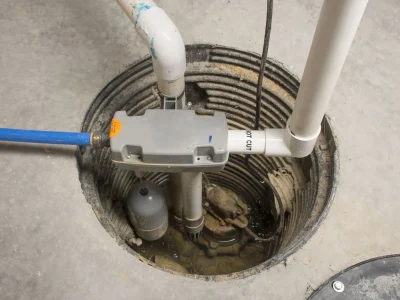
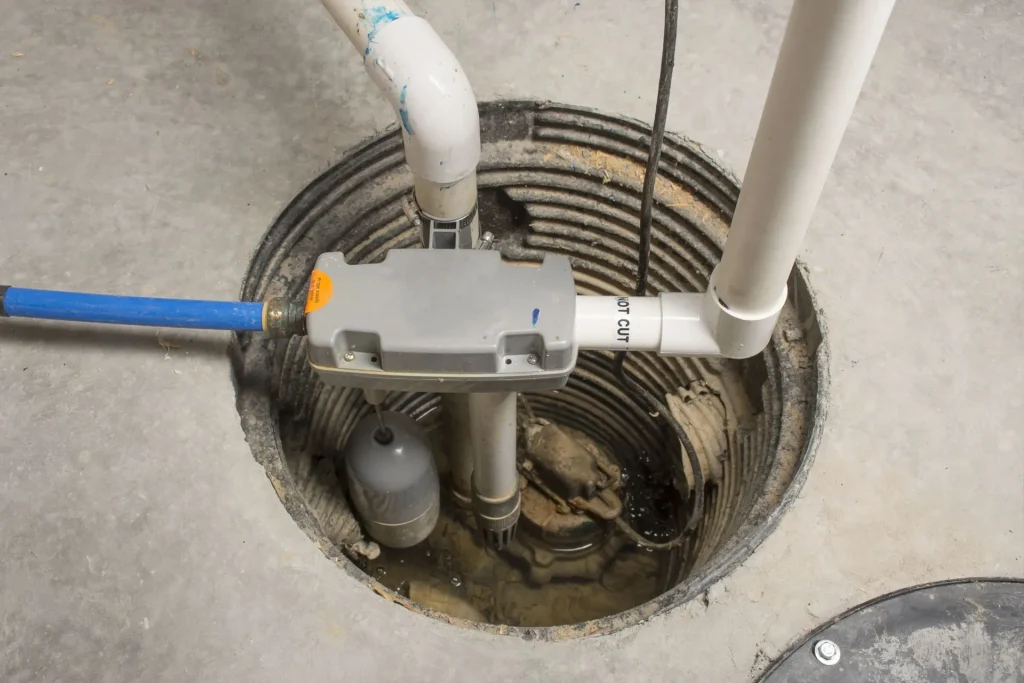
A sump pump exists to move groundwater and storm water out of a building through piping. That’s storm water and liquid waste, moved through drains. It sits inside the definition.
The regulation also notes an outer boundary: connections extending more than 3 feet beyond a building’s property line fall outside it.
So does the work need a licensed plumber?
Where the work is plumbing under that definition, New Jersey’s State Plumbing License Law of 1968, N.J.S.A. 45:14C, requires it to be performed by a licensed master plumber, or by someone working under the required supervision. That’s the general rule, and it applies in West Caldwell the same as anywhere else in the state, because licensing is set at state level and not by the township.
Where it gets more nuanced is the discharge. If the sump pump’s discharge line is installed so it doesn’t connect to the building’s existing plumbing system, and instead runs out through the wall and away from the house, the plumbing licensing requirement may not attach in the same way. Where the discharge ties into the building’s drainage piping, it clearly does.
That’s a distinction worth raising directly with whoever is quoting the job, because it determines who is legally permitted to do it. Ask the question plainly: “Does this work connect to the building’s plumbing system, and if so, who holds the licence?”
A note on how contracting actually works. Plenty of reputable waterproofing companies are not themselves plumbing firms, and they bring in a licensed plumber for the portion of the job that requires one. That’s a normal and correct arrangement. What matters is that the arrangement exists and that someone can name who holds the licence.
Can I install my own sump pump as a homeowner?
There is an exemption, and it’s narrower than people expect.
N.J.S.A. 45:14C-12.4 provides that the act “shall not apply to a single family home owner who performs plumbing work on his own dwelling.” That statutory text was current as of January 1, 2024.
Four limits worth understanding before relying on it.
It covers you, not someone you hire. The exemption attaches to the homeowner performing the work personally. It does not let you hire an unlicensed handyman and treat their work as covered. This is the single most common misunderstanding.
It’s tied to your own single-family dwelling. It’s generally understood to apply to an owner working on their own home, not to rental property being worked on as a business.
It is not a permit exemption. Licensing and permitting are separate systems. Work that needs a construction permit still needs one, and it still gets inspected.
Doing it yourself doesn’t lower the standard. The work still has to meet code, and an inspector holds it to the same standard.
If any of that is unclear for your situation, the West Caldwell Construction Department at 973-226-2302 can tell you what your specific project requires.
What about swapping a failed pump for a new one?
This is the most common real-world scenario, and it’s genuinely different from a new installation.
Replacing a pump in an existing basin, using the existing discharge piping, is a smaller job than creating a new sump, cutting a basin into the slab, and running new discharge. Whether it rises to permit-triggering work depends on what’s being altered, and the construction office makes that determination.
Where the replacement involves altering, extending, or replacing the discharge piping, you’re back inside the plumbing definition. Where it’s genuinely a like-for-like unit swap in an existing installation, the analysis is different. Don’t assume, and don’t let a company tell you it’s nothing without saying why.
How to verify a licence before you hire
Four things to check, and none of them take long.
Ask for the master plumber licence number for the person or firm doing the plumbing-connected portion, and verify it through the New Jersey Division of Consumer Affairs. Licences are publicly searchable.
Ask for the New Jersey Home Improvement Contractor registration number. This is a separate registration from a plumbing licence, and most home improvement work in New Jersey requires it. A company should give you both numbers without hesitating.
Ask for the certificate of insurance, and ask that it be sent by the insurer instead of as a photocopy.
Ask who pulls the permit and get it in writing.
If any of those four questions produces a vague answer, that’s information.
What actually goes wrong with unlicensed work
The consequences show up later, which is why this feels theoretical until it isn’t.
At resale. Buyers’ inspectors flag sump systems, and unpermitted or non-compliant work becomes a negotiating item at the worst possible moment.
With a claim. If a discharge was installed improperly and water damage follows, how that interacts with a homeowners policy is a question you don’t want to discover during a claim.
With the enforcing agency. Work done without a required permit may have to be opened up for inspection or redone.
With the discharge itself. A common failure is a discharge routed into a sanitary sewer, which is generally prohibited, or terminated too close to the foundation so the same water returns to the same soil. Both are the sort of thing a licensed installer is trained to avoid.
Frequently Asked Questions
Do you have to be a licensed plumber to install a sump pump in New Jersey?
Generally yes, where the work is plumbing under N.J.A.C. 13:32-1.3, which covers storm water drains and liquid waste piping. For that work the State Plumbing License Law, N.J.S.A. 45:14C, requires a licensed master plumber, or someone working under the required supervision. A narrow exemption exists for homeowners working on their own dwelling.
Can a homeowner install their own sump pump in West Caldwell?
N.J.S.A. 45:14C-12.4 exempts a single-family home owner performing plumbing work on their own dwelling from the licensing act. The exemption does not extend to anyone they hire, and it does not remove any permit requirement.
Can a handyman install a sump pump if I own the house?
Not on the strength of your ownership. The exemption in N.J.S.A. 45:14C-12.4 applies to the owner doing the work personally, and it cannot be used to authorize unlicensed work by someone you hire. Whether the particular job requires a licensed plumber at all depends on whether it involves the building’s plumbing or drainage piping.
Does replacing an existing sump pump need a licensed plumber?
It depends on what’s being altered. A like-for-like unit swap in an existing basin is analyzed differently from work that alters, extends, or replaces discharge piping. Confirm with the West Caldwell Construction Department at 973-226-2302.
How do I check whether a plumber is licensed in New Jersey?
Master plumber licences are searchable through the New Jersey Division of Consumer Affairs. Ask separately for the company’s Home Improvement Contractor registration number, which is a different credential.
About ARD Waterproofing
ARD Waterproofing is a residential waterproofing company based at 98 Smull Ave in West Caldwell, New Jersey, serving West Essex, Passaic, and Morris counties.
The company installs sump pump systems, interior and exterior French drains, and the discharge and grading work that determines whether a pump actually solves the problem.
Owner David Roth personally evaluates properties in West Caldwell, Livingston, and along the Bloomfield Avenue corridor before a job is priced, which includes establishing what the sump discharge needs to connect to. That’s the detail this whole question turns on.
ARD Waterproofing is registered as a New Jersey Home Improvement Contractor, registration number 13VH12460700. The company does not hold a New Jersey master plumber licence in-house; per owner David Roth, ARD’s position is that its sump pump and drainage installations do not require one. That’s the company’s own representation and not a determination this article makes, so the guidance above still stands for any company you’re evaluating, ARD included: ask who holds the plumbing licence for the portion of the job that needs one, and verify any licence number independently through the New Jersey Division of Consumer Affairs.
To discuss a sump pump installation or replacement in West Caldwell, call (201) 646-5936.
This article is general information about New Jersey licensing and construction requirements. It is not legal advice, and it is not a determination about any specific project. Requirements depend on the scope of the work and are applied by the local enforcing agency. Confirm with the Township of West Caldwell Construction Department and, where appropriate, a licensed professional.
Sources
- N.J.A.C. 13:32-1.3, definition of plumbing, New Jersey State Board of Examiners of Master Plumbers
- N.J.A.C. 13:32-1.4, scope of practice
- N.J.S.A. 45:14C, The State Plumbing License Law of 1968
- N.J.S.A. 45:14C-12.4, single family home owner exemption, current as of January 1, 2024
- N.J.A.C. 5:23, New Jersey Uniform Construction Code
- Township of West Caldwell, Construction Department
- New Jersey Division of Consumer Affairs, licence verification
 Do You Need a Permit to Install a French Drain in West Caldwell, NJ?