
Quick Answer: It depends on what the drain connects to. A shallow yard drain that carries surface water and touches no building piping often falls outside permit requirements. A drain tied into the building’s drainage piping, or one paired with a new sump, generally does require a construction permit. Confirm with West Caldwell’s Construction Department at 973-226-2302.
Most articles answer this with “it varies by town,” which is true and useless. In New Jersey the framework is actually statewide, set by the Uniform Construction Code, and the local department applies it. That means you can work out where your project probably lands before you pick up the phone.
The deciding factor is almost never how big the trench is. It’s whether the work touches the building’s drainage piping. New Jersey’s code draws a hard line there, and once you know which side of the line your project sits on, the permit answer follows.
There’s a second obligation that catches homeowners out, and it has nothing to do with permits. Any excavation in New Jersey requires a utility markout before a shovel goes in the ground. That one is a state law, it applies to homeowners as well as the crews they hire, and it needs at least 3 full business days of lead time. Skipping it is the most common mistake on a do-it-yourself drainage project.
This article covers the code tiers, four real scenarios, the markout requirement, and the flood hazard wrinkle specific to West Caldwell.
📊 At a Glance
- The deciding question: does the drain connect to the building’s drainage piping, or only move surface water across the yard?
- Three code tiers under the Uniform Construction Code: ordinary maintenance (no permit), minor work (permit, no plan review), and full permit work
- Drainage piping is explicitly excluded from ordinary maintenance under N.J.A.C. 5:23-2.7
- Markout is mandatory before any excavation: New Jersey One Call, 811, minimum 3 full business days’ notice
- West Caldwell Construction Department: 30 Clinton Road, West Caldwell, NJ 07006, 973-226-2302
- Extra layer if you’re in a flood hazard area: the township’s Chapter 21 floodplain regulations, plus state rules that can reach beyond the FEMA mapped area
How New Jersey sorts construction work into tiers
The Uniform Construction Code puts residential work into three buckets, and the bucket determines the paperwork.
Ordinary maintenance. No permit, no notice to the enforcing agency. N.J.A.C. 5:23-2.7 lists what qualifies. On the plumbing side it covers things like clearing stoppages, replacing traps, and replacing valves.
The part that matters here sits in the exclusions. Alterations, additions, and replacements of “water supply, sewer, drainage, gas, soil, waste, vent or similar piping” are specifically excluded from ordinary maintenance. A French drain that ties into building drainage piping is not maintenance under this code, and that single line answers a large share of French drain permit questions.
Minor work. A permit is required, but the work can begin on filing and doesn’t wait for plan review. N.J.A.C. 5:23-2.17A(c)(2) covers plumbing items including replacement of existing plumbing piping with new approved material of like capacity.
Full permit work. Everything else. Application, review, permit, inspections.
Your township applies these tiers. It doesn’t invent its own.
Four scenarios, and where each usually lands
These are the four shapes a West Caldwell French drain project usually takes. Treat this as orientation, and confirm your specific project with the Construction Department, because they make the determination and you don’t.
1. Shallow exterior yard drain, discharging to daylight. Perforated pipe in stone, set in the lawn to intercept surface water, running to a low point on the property where it exits above grade. It touches no building piping. This is the scenario most likely to fall outside construction permit requirements. Zoning, grading, and drainage rules may still apply, especially if the discharge changes how water leaves your property or where it goes next.
2. Exterior footing drain against the foundation. Excavation to the footing, drain pipe in stone alongside the wall, usually with membrane. Deeper, closer to the structure, and more likely to involve the building’s drainage. More likely to need a permit, and much more likely to need a markout done properly.
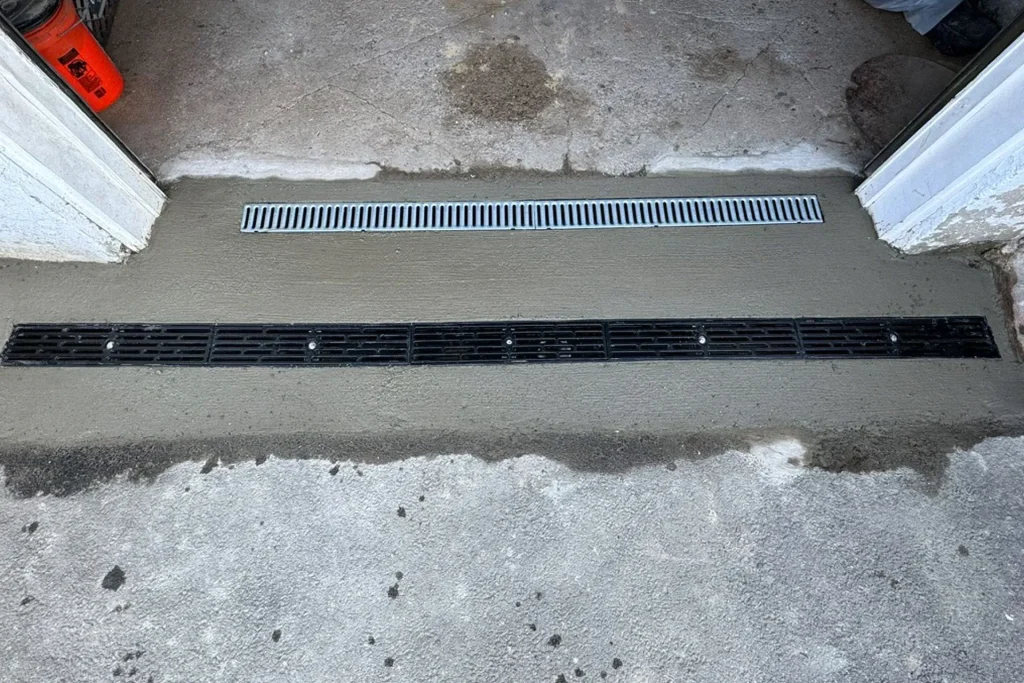
3. Interior perimeter drain routed to a new sump. Channel cut in the slab, pipe in stone, discharging to a sump basin and pump. This creates and connects drainage piping, and it typically falls on the permit side of the line. If the sump discharge is plumbed into the building’s system, that raises a separate licensing question covered in a companion article on sump pumps.
4. Connecting a drain to an existing sewer line. Worth flagging plainly. Routing groundwater or storm water into a sanitary sewer is commonly prohibited, and it can create problems well beyond a permit issue. Do not assume an existing connection you inherited is legal.
The markout requirement nobody mentions
New Jersey’s Underground Facility Protection Act, N.J.S.A. 48:2-73 and following, requires notification before excavation. It applies to homeowners and to the people they hire.
How it works:
- Call 811 or 800-272-1000, or file online with New Jersey One Call
- Wait a minimum of 3 full business days, not counting weekends or holidays
- Don’t request more than 10 days ahead of the work
- The markout is good for 45 business days
- Hand dig within 2 feet on either side of any marked line
The paint and flag colors follow a national standard: red for electric, yellow for gas and oil, orange for communications, blue for water, green for sewer, and white to outline the proposed dig.
A French drain is a trench, often 12 to 36 inches deep, frequently running along a property line where the utility laterals are. That’s precisely the profile where an unmarked gas or electric service gets hit. The markout is free and the lead time is the only real cost.
The West Caldwell flood hazard layer
West Caldwell has participated in the National Flood Insurance Program since April 16, 1979, and the township maintains floodplain management regulations in Chapter 21 of its code. FEMA identified Special Flood Hazard Areas for Essex County in a Flood Insurance Study dated April 3, 2020.
If your property sits in a mapped flood hazard area, work that changes grade, fill, or drainage can carry review requirements beyond the standard construction permit. New Jersey’s regulated flood hazard area can also be broader than the FEMA mapped area, so being outside the FEMA line isn’t automatically the end of the question.
If any part of your lot is near the mapped area, raise it with the Construction Department before the trench is dug, not after.
How to actually confirm it for your project
The township’s own guidance is to contact them and ask. That’s the correct route, and it costs one phone call.
Township of West Caldwell, Construction Department
30 Clinton Road, West Caldwell, NJ 07006
973-226-2302
Have ready: where the drain will run, how deep, what it connects to at both ends, where it discharges, and whether a sump or pump is part of it. Those five details are what the determination turns on.
One current process note: building inspections must now be requested in writing, through the township’s portal or by email, and verbal requests are no longer accepted. Worth knowing before you schedule.
If you hire a company for the work, ask directly who pulls the permit. It should be settled in writing before work starts.
Frequently Asked Questions
Do I need a permit for a French drain in my yard in West Caldwell?
A shallow yard drain that only moves surface water and connects to no building piping often falls outside construction permit requirements, but zoning and drainage rules may still apply. Confirm with the Construction Department at 973-226-2302.
Does an interior French drain need a permit in New Jersey?
Usually yes. An interior perimeter drain creates and connects drainage piping, and N.J.A.C. 5:23-2.7 specifically excludes drainage piping work from ordinary maintenance, which is the no-permit tier.
Do I have to call 811 before digging a French drain on my own property?
Yes. New Jersey’s Underground Facility Protection Act requires markout notification before excavation, with a minimum of 3 full business days’ notice. It applies to homeowners as well as hired crews.
Who pulls the permit, me or the company doing the work?
Either can, and it should be agreed in writing before work begins. Ask the question during the estimate.
What happens if a French drain is installed without a required permit?
Unpermitted work can create issues at resale, during a home inspection, and with the enforcing agency. If you inherited work you suspect was unpermitted, the Construction Department is the right first call.
About ARD Waterproofing
ARD Waterproofing is a residential waterproofing company based at 98 Smull Ave in West Caldwell, New Jersey, serving West Essex, Passaic, and Morris counties.
The company installs interior and exterior French drains, sump pump systems, and the grading and discharge work that goes with them.
Owner David Roth personally evaluates properties in West Caldwell, Livingston, and along the Bloomfield Avenue corridor before a job is priced, which includes working out what the drain needs to connect to. That determination is what drives the permit question.
To talk through a drainage project in West Caldwell, call (201) 646-5936.
This article is general information about New Jersey construction code and is not legal advice. Permit determinations are made by the local enforcing agency for each specific project. Confirm requirements with the Township of West Caldwell Construction Department before starting work.
Sources
- N.J.A.C. 5:23-2.7, Ordinary maintenance, New Jersey Uniform Construction Code
- N.J.A.C. 5:23-2.17A, Minor work, New Jersey Uniform Construction Code
- N.J.S.A. 48:2-73 et seq., Underground Facility Protection Act
- New Jersey One Call, markout notice requirements
- Township of West Caldwell, Construction Department
- Township of West Caldwell, Chapter 21, Floodplain Management Regulations
- FEMA Flood Insurance Study for Essex County, New Jersey, dated April 3, 2020
 Can You 100% Waterproof a Basement in West Caldwell?