
Quick Answer: You can get a West Caldwell basement to stay dry through every storm it will realistically see. What you cannot buy is a foundation that is waterproof as a permanent physical property. A well built system manages water continuously, and it depends on power, maintenance, and a working discharge point to keep doing it.
Homeowners ask this question after someone has already used the word “permanent” in a sales conversation. It’s a fair question, and the honest answer has two halves.
The first half is encouraging. A basement that floods twice a year can be made into a basement that stays dry, and that outcome is achievable in almost every house in West Caldwell. Interior perimeter drainage tied to a properly sized sump pump, combined with corrected grading and working downspout discharge, handles the water that reaches most foundations in Essex County.
The second half is the part that gets skipped. “Waterproof” describes a condition your foundation is held in, not a state it gets converted to. A poured concrete wall and a block wall both admit water under pressure, and the joint where the wall meets the floor slab is a seam by design, not a defect. Systems don’t seal that seam shut. They collect what comes through it and move it somewhere else, continuously, for as long as they have power and a clear discharge.
So the useful question isn’t whether you can hit 100%. It’s which of the three water paths into your basement a given proposal actually addresses, and what happens to the system on the night the power fails. This article covers both, plus what to ask before you sign anything.
📊 At a Glance
- Achievable outcome: a basement that stays dry in normal and heavy rain, with a system that runs continuously
- Not achievable: a foundation that is waterproof as a permanent property with no power, maintenance, or discharge
- Three water paths: hydrostatic pressure through the wall and cove joint, surface water and grading, and plumbing or appliance failure
- The single most common miss: downspouts and grading, which no interior system addresses
- The usual failure point: the sump pump’s power supply and its discharge line, not the drainage itself
- West Caldwell context: the township joined the National Flood Insurance Program in 1979, and FEMA mapped Special Flood Hazard Areas for Essex County in a study dated April 3, 2020
What does “100% waterproof” actually mean?
In construction, waterproofing and damp-proofing are different things, and the word gets used loosely in sales.
Damp-proofing is the black asphalt coating sprayed on foundation walls at the time of construction. It slows moisture. It’s not designed to hold back standing water under pressure, and on a house built decades ago it has usually degraded.
Waterproofing, done properly, is a membrane or a drainage assembly designed to handle liquid water under hydrostatic pressure. Even then, it’s a system with parts. Membranes get punctured by backfill. Drainage pipe silts up. Pumps fail.
When a company says a basement will be “100% waterproof,” the defensible version of that claim is about the outcome: your basement will stay dry. That’s a service promise, and it’s a reasonable one to make. The version that isn’t defensible is the physical one, that the building has been converted into something water can no longer enter. Ask which version is being offered, and ask for it in writing.
Where does water get into a West Caldwell basement?
There are three paths, and they need different fixes. A proposal that addresses one and ignores the other two produces a homeowner who paid for waterproofing and still has a wet basement.
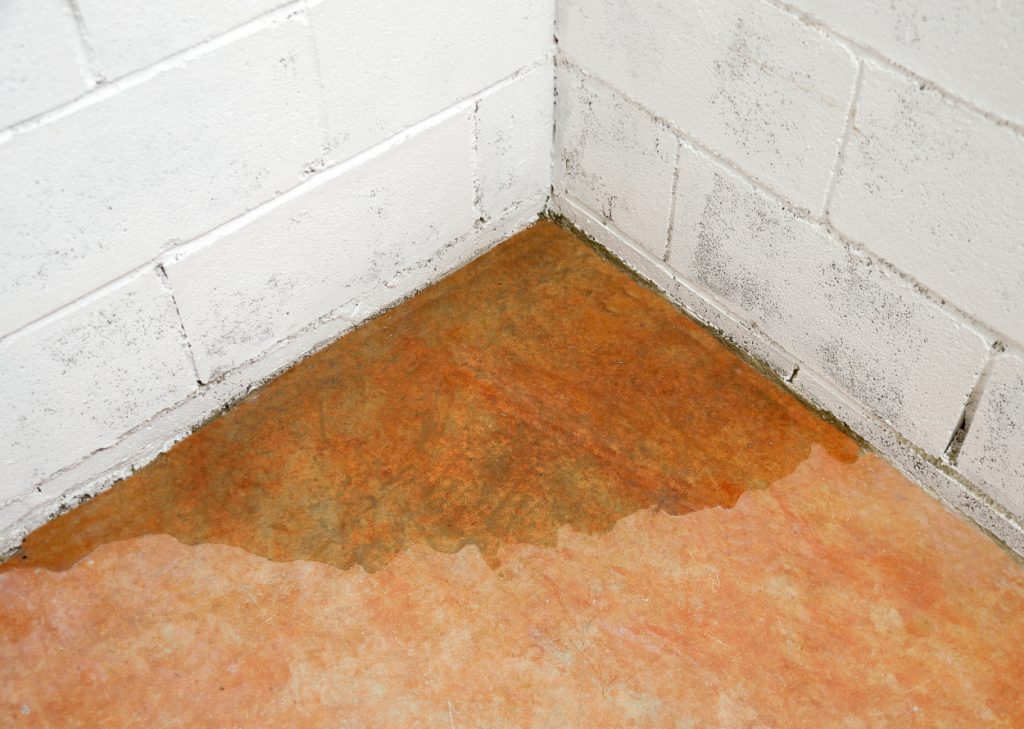
Hydrostatic pressure. After rain, the soil around your foundation holds water. That water has weight, and it pushes. It finds the cove joint where the floor slab meets the wall, mortar joints in block walls, tie-rod holes in poured walls, and any crack that has opened as the house settled. This is the path interior drainage systems are built for.
Surface water. Water that never should have reached the foundation in the first place. Downspouts dumping at the corner of the house. Grade that slopes toward the building instead of away. A patio or walkway that has settled and now directs runoff back at the wall. This is the cheapest problem to fix and the one most often left in place after an expensive interior job.
Plumbing and appliances. A failed water heater, a burst supply line, a washing machine hose. No waterproofing system on earth addresses this, and it matters for a separate reason: this is the category your homeowners policy is most likely to treat differently from groundwater.
Most wet basements in older Essex County housing stock involve at least two of the three. That’s why a walkthrough that only looks at the inside of the basement isn’t a diagnosis.
Can an interior drainage system keep a basement 100% dry?
An interior perimeter system is the workhorse, and it’s effective. Here’s what it does and doesn’t do.
The installer breaks a channel in the slab around the perimeter, sets perforated pipe in stone, and routes it to a sump basin. Water arriving through the cove joint and the lower wall drops into the channel and gets pumped out. Wall vapor barrier directs water coming through the wall down into the same channel.
What it does well: it intercepts water reliably at the exact place most water enters, and it works regardless of how saturated the soil outside gets.
What it does not do: it doesn’t stop water from entering. It relieves the pressure and gives the water a managed path. That distinction matters when someone tells you the basement will be “sealed.”
And it has three dependencies. It needs electricity. It needs the discharge line to stay clear and to terminate somewhere that doesn’t send the water straight back toward the house. And it needs the basin and the check valve to be maintained. A system that hasn’t been looked at in 8 years is not the system that was installed.
Does exterior waterproofing get you closer to 100%?
Sometimes, and it costs considerably more.
Exterior work means excavating to the footing, cleaning the wall, applying a membrane, and installing a footing drain in stone with filter fabric. It addresses water before it reaches the wall instead of after, which is genuinely better engineering.
The reasons it’s less common on an existing West Caldwell home are practical. Excavation around a finished house means the deck, the patio, the mature plantings, the AC condenser, and the utility lines are all in the way. On a lot where the neighboring house is close, there may not be room to dig at all. And once the wall is backfilled again, the membrane is unreachable, so a defect that shows up in year 12 is expensive to reach.
Exterior work also triggers the excavation obligations covered in a separate article: a New Jersey One Call markout is required before any digging, with a minimum of 3 full business days’ notice.
It gets you closer. It doesn’t get you to a state where the system stops mattering.
What stops a “100% dry” basement from staying dry?
Systems that were correctly installed still fail, and the failures cluster.
Power loss during the storm that matters. The heaviest rain and the power outage arrive together more often than homeowners expect. A sump pump with no battery backup and no water-powered backup is a pump that’s offline exactly when it’s needed. This is the single most common reason a “waterproofed” basement floods.
Discharge that goes nowhere useful. A discharge line that ends 4 feet from the foundation returns the same water to the same soil. In winter, a discharge line that isn’t pitched to drain can freeze, and a frozen line means the pump runs against a closed pipe until it burns out.
The grading nobody corrected. If the surface water path was never fixed, the interior system now handles volume it was never sized for, and it runs constantly.
Deferred maintenance. Check valves stick. Basins fill with silt from the drainage stone. Float switches hang up on the basin wall. None of this is exotic, and all of it is invisible until the water is on the floor.
A changed house. A new patio, a regraded yard next door, a neighbor’s new downspout run. The water table around your foundation isn’t a fixed quantity.
What should a West Caldwell homeowner actually ask for?
Skip the word “guaranteed” and ask these instead.
“Which of the three water paths does this proposal address?” If the answer only covers hydrostatic pressure, ask what the plan is for grading and downspouts. It may genuinely be nothing, and that’s fine if it’s said out loud.
“What’s the backup plan when the power goes out?” Battery backup, water-powered backup, or a generator circuit. If none of the three is in the proposal, the system has a single point of failure.
“Where does the discharge terminate, and how far from the house?”
“What’s the maintenance schedule, and who does it?”
“What exactly does the warranty cover, and does it transfer if I sell?” Get the terms in writing, including what voids it. A warranty that covers the system but excludes water entering through a path the system was never built to address is a normal and honest warranty. You just want to know that before, not after.
“Can I see a job you did in West Caldwell or one of the neighboring Caldwells?”
Key Takeaways
- A dry basement is an achievable outcome. A permanently waterproof foundation is not a purchasable object.
- Water reaches a basement by 3 paths, and interior drainage addresses 1 of them thoroughly.
- Grading and downspout discharge are the cheapest fix available and the most commonly skipped.
- The most frequent cause of a flooded “waterproofed” basement is a sump pump with no power backup.
- Every system has a maintenance requirement. A system nobody has inspected in years is not performing as designed.
- Ask what a warranty excludes, not just what it covers.
Frequently Asked Questions
Is a basement ever truly 100% waterproof?
As a permanent physical property, no. As an outcome, a basement can stay dry through every storm it realistically encounters, provided the system has power, maintenance, and a working discharge point.
Does an interior drainage system stop water from entering the foundation?
No. It relieves hydrostatic pressure and gives water a managed path to a sump and out of the house. That’s a different mechanism from sealing, and it’s the mechanism that works reliably on an existing home.
Will fixing my downspouts and grading be enough on its own?
Sometimes. If the water reaching your foundation is mostly surface runoff, correcting discharge and slope can resolve it at a fraction of the cost. It’s worth ruling in or out before committing to interior work.
Why did my basement flood after I had it waterproofed?
The most common reasons are a power failure that took the sump pump offline, a discharge line that froze or was blocked, an uncorrected surface water path, or maintenance that lapsed. Each is diagnosable.
Does the age of my West Caldwell home change the answer?
It changes the likely entry points more than the outcome. Older block foundations tend to admit water through mortar joints, and newer poured walls through tie-rod holes and shrinkage cracks. Both are manageable.
About ARD Waterproofing
ARD Waterproofing is a residential waterproofing company based at 98 Smull Ave in West Caldwell, New Jersey, serving West Essex, Passaic, and Morris counties.
The company focuses on basement waterproofing, interior and exterior French drains, sump pump systems, crawl space work, and the drainage and grading corrections that sit alongside them.
Owner David Roth personally evaluates properties in West Caldwell, Livingston, and along the Bloomfield Avenue corridor before a job is priced. On a question like this one, that matters, because the difference between a surface water problem and a hydrostatic problem is something you determine at the house.
To discuss a wet basement in West Caldwell or a neighboring town, call (201) 646-5936.
This article is general information about residential drainage and waterproofing. It is not a diagnosis of any specific property, and it is not legal, insurance, or engineering advice. Conditions vary by house.
Sources
- New Jersey Uniform Construction Code, N.J.A.C. 5:23
- Township of West Caldwell, Chapter 21, Floodplain Management Regulations
- FEMA Flood Insurance Study for Essex County, New Jersey, dated April 3, 2020
- New Jersey One Call, Underground Facility Protection Act, N.J.S.A. 48:2-73 et seq.
 How Much Does a Plumber Charge to Install a Drain in West Caldwell, NJ?