
Quick Summary
- An exterior French drain installation in West Caldwell, NJ, doesn’t have to mean a destroyed yard — a meticulous crew can leave your property looking like they were never there.
- ARD Waterproofing uses a proprietary Root & Hardscape Navigation Protocol to hand-dig around mature tree roots and patio pavers, protecting what matters most to you.
- Real cleanup. Real restoration. A real warranty. Here’s exactly how the process works, start to finish.
You’ve got standing water pooling against your foundation after every rainstorm. You know you need an exterior French drain. But every time you’re about to pick up the phone, the same thought stops you cold:
“What are they going to do to my yard?”
It’s a completely fair question. You’ve spent years — and real money — building a lawn you’re proud of. Maybe there’s a bluestone patio back there. A row of mature arborvitae along the property line. A garden your family actually cares about. The idea of a crew showing up with heavy equipment and leaving behind a muddy, torn-up mess is enough to make anyone hit pause.
Here’s the honest answer: with the right contractor, your yard doesn’t have to suffer. The difference comes down entirely to how a crew prepares, digs, and cleans up after themselves.
Let us walk you through exactly how we handle it.
The Myth of the Destroyed Yard
Most horror stories about trashed landscaping after drainage work come from one source: contractors who treat cleanup as an afterthought.
They get the pipe in the ground, the water redirected, and they’re gone. The restoration? That’s your problem.
We’ve heard it from homeowners all over West Caldwell, Verona, and Caldwell borough say “the last company left my yard looking like a construction site.” That’s an accountability problem.
At ARD, we’re employee-owned. Every person on our crew has a personal stake in the quality of the work, including how your property looks when we pull out of the driveway. Our standard isn’t “we fixed the water.” It’s “you could barely tell we were ever there.”
Before We Dig: The Pre-Job Property Walk
The process starts before a single shovel hits the ground.
Before any exterior French drain installation, our lead specialist walks the entire work area with you. We’re looking for the things that matter to you —the patio edge, the tree with the root system that spreads wide, the garden bed you don’t want disturbed, the buried irrigation line.
We mark it all. We talk through it. Nothing is a surprise on job day.
This is also where we assess New Jersey’s notoriously clay-heavy soil. Clay soil holds water (which is often why you have a drainage problem in the first place), and it also makes excavation messier if you don’t plan for it. We do.
How We Dig Around What You’ve Built
This is the part no competitor talks about and it’s the most important part.
The Root & Hardscape Navigation Protocol
When a trench line runs near a mature tree or alongside a patio, we don’t just swing a machine at it and hope for the best. We switch to hand tools.
For tree roots, we use narrow spades and hand trowels to carefully expose and work around root systems, cutting only what’s structurally necessary and never compromising the root ball. In North Jersey, mature oaks and maples are irreplaceable — and we treat them that way.
For hardscaping —bluestone, pavers, concrete edging— we remove sections by hand, piece by piece, numbering them if needed so they go back in the exact same position. No cracked pavers. No shifted edges.
For tight spots along NJ’s notoriously narrow property lines, we use compact, low-impact equipment that can maneuver without tearing up adjacent lawn areas.
The Installation: What’s Actually Happening Underground
Once the trench is open, here’s what goes in:
- A gravel bed is laid at the correct grade to ensure water flows toward the designated outlet point
- A perforated PVC pipe is set into the gravel — this is the actual drain that captures and redirects water away from your foundation
- Filter fabric wraps the system to keep clay and fine soil particles from clogging the pipe over time (critical in NJ’s clay-heavy ground)
- The trench is backfilled in layers, compacted properly so the ground doesn’t settle unevenly later
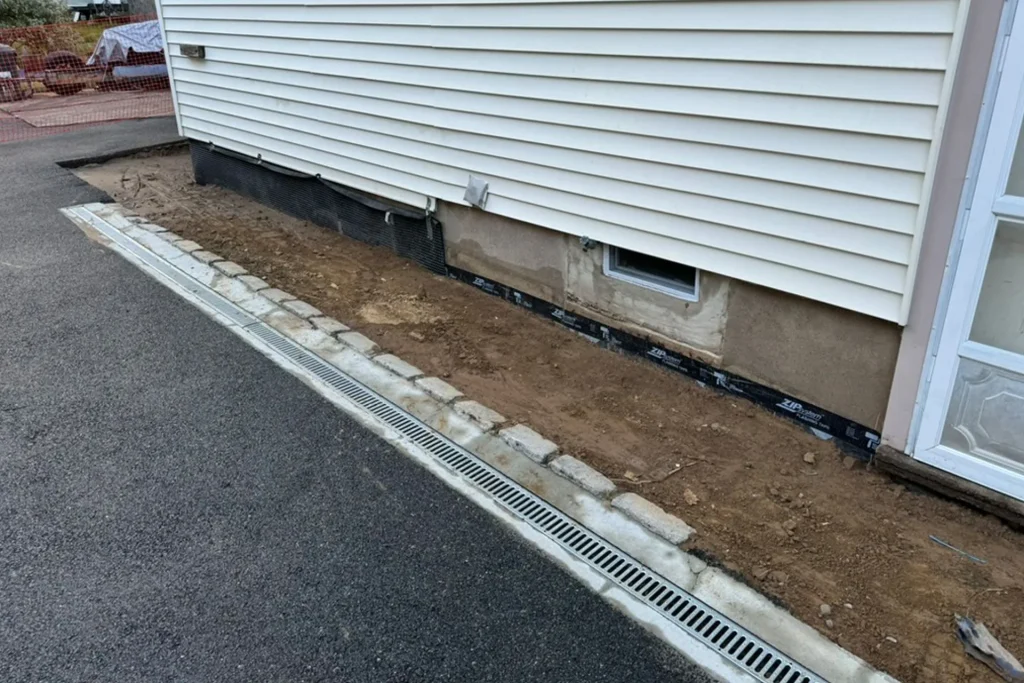
The whole system is designed to be invisible once it’s done. No exposed pipes. No visible gravel patches. Just a yard that drains the way it should.
If you’re weighing your options, it’s worth understanding the full picture — here’s a comparison of [exterior vs. interior French drains] to help you decide which system actually fits your situation.
The Cleanup: This Is Where We’re Different
When the pipe is in and the trench is backfilled, most of the work is done. But for us, this is where we slow down.
Topsoil is regraded and smoothed to match the surrounding lawn. Sod is relaid where it was removed — not just tossed back, but properly seated. Hardscape sections are reset by hand, leveled, and checked. Any debris, excess soil, or materials are loaded and removed from the property.
We don’t leave a pile of dirt “for the homeowner to deal with.” We don’t call the job done when the pipe is in. The job is done when your yard looks right.
One of our recent clients in West Caldwell — a homeowner on Westover Road who had us install a full perimeter exterior drain system — put it simply: “I honestly couldn’t tell where they had dug. The lawn looked like it always did. I was shocked.”
That’s the standard we hold ourselves to on every job.
How Long Does the Yard Take to Recover?
This is one of the most common questions we get, so let’s answer it directly.
Immediately after the job: The work area will look freshly graded — clean, but clearly worked. Sod that was relaid needs a few days to re-root.
After 1–2 weeks: With normal watering, relaid sod typically knits back together, and you lose the visible seam lines.
After one growing season: In most cases, you genuinely cannot tell where the trench was. The lawn fills in completely.
If there’s a section where grass needs to be reseeded rather than sodded, we’ll tell you that upfront — and walk you through the best approach for your specific lawn type.
Protecting Your Property Value, Not Just Your Basement
Here’s the bigger picture: an exterior French drain done right doesn’t just protect your foundation. It protects your investment.
Water damage is one of the top issues that kills home sales in Essex and Morris County. A properly installed, documented drainage system — especially one backed by a 100% Lifetime Transferable Warranty — is a genuine asset when it comes time to sell. Buyers see it. Inspectors note it. It’s proof that the home was cared for.
The goal isn’t just a dry basement. It’s a home that’s worth more, lasts longer, and never gives you a reason to worry every time a storm rolls in off the Watchung Mountains.
Ready to find out what the right solution looks like for your property? [Schedule a respectful property assessment] — no pressure, no upsell, just an honest look at what’s going on and what it’ll take to fix it.
Conclusion: The Right Crew Leaves No Trace
Exterior waterproofing doesn’t have to mean a torn-up yard. It means choosing a contractor who takes the restoration as seriously as the installation.
At ARD Waterproofing, we’ve been doing this work in West Caldwell and across West Essex, Passaic, and Morris counties for over a decade. We show up on time, we communicate throughout the job, and we leave your property cleaner than we found it. That’s not a marketing line — it’s the standard our employee-owned crew holds itself to on every single project.
Don’t let fear of property damage delay a repair your home actually needs.
Call or text us anytime — we’re available 24 hours. Ask about our [exterior French drain installation process] and get a competitive estimate we’ll honor, no matter what the job turns into.
Military and first responders receive a 12% discount. NJ Contractor License proudly displayed.
Frequently Asked Questions
Will a French drain ruin my existing landscaping?
Not with the right contractor. A meticulous crew will remove hardscaping by hand, work carefully around tree roots, relay sod, and regrade topsoil so the yard looks essentially undisturbed once the job is complete. The key is choosing a company that treats restoration as part of the job — not an afterthought.
Do waterproofing companies replace concrete and patios after excavation?
A quality waterproofing contractor will remove and reset patio pavers, concrete edging, and hardscape sections by hand during the installation process. At ARD, we number and document sections before removal, so everything goes back in the correct position. If any piece is damaged during the process, we address it before we leave.
How long does the yard take to recover after trenching?
Relaid sod typically re-roots within 1–2 weeks with regular watering. After one full growing season, most lawns show no visible evidence of where the trench was dug. Seeded areas take slightly longer depending on grass variety and weather, but we’ll walk you through the right approach for your specific lawn before we start.
 The Physics of Hydrostatic Pressure: What’s Actually Pushing Water Into Your Basement