

Quick Summary
- Interior and exterior waterproofing are fundamentally different: one manages water that gets in, the other blocks it from entering in the first place — and choosing the wrong one for your symptoms is an expensive mistake.
- New Jersey’s soil diversity (dense red clay in Hunterdon County, sandy coastal soil in Monmouth, glacial till in Morris County) and brutal freeze-thaw cycles make the “right” choice highly location-specific.
- The fastest path to the correct answer isn’t a pros/cons list — it’s matching your specific leak symptom to the system engineered to solve it.
You’ve noticed something. Maybe it’s a damp smell after a hard rain. Maybe it’s an actual puddle forming in the corner of your basement every time a nor’easter rolls through. You’ve started Googling, you’ve gotten a couple of estimates, and now you’re staring at two very different proposals — one for interior drainage, one for exterior excavation — with a $15,000 gap between them.
So which one do you actually need?
Here’s the honest answer: it depends entirely on where your water is coming from and what your foundation is doing. This guide is built to help you figure that out —without the sales pressure.
The Core Difference: Management vs. Prevention
This is the most important distinction in the entire conversation, and most contractors gloss right over it.
Exterior waterproofing is true waterproofing. You’re excavating down to the foundation footing, applying a waterproof membrane to the outside of the wall, and physically stopping water from ever making contact with your foundation. Think of it like a raincoat for your house’s foundation. Water hits the membrane, runs down into a footer drain, and gets directed away. Done.
Interior waterproofing is water management. You’re not stopping water from entering the wall — you’re intercepting it at the cove joint (where the floor meets the wall), routing it through a sub-floor drainage channel, and pumping it out before it can cause damage. Think of it less like a raincoat and more like a very efficient gutter system inside your basement.
Neither approach is a scam. Both are legitimate, proven engineering solutions. The problem only happens when the wrong one gets applied to the wrong situation.
For a deeper look at how these systems integrate with your overall foundation health, see our foundation waterproofing options page.
Why New Jersey Makes This More Complicated
NJ isn’t a monolith when it comes to soil and groundwater —and that matters enormously here.
If your home sits in Hunterdon or Somerset County, you’re likely dealing with dense, expansive red clay from the Piedmont region. That clay holds water like a sponge, creating sustained lateral hydrostatic pressure against your foundation walls for days after a storm. That’s a very different problem than what homeowners in Monmouth or Ocean County face, where sandy coastal soils drain quickly but can allow rapid water infiltration under the footing.
Up in Morris and Passaic Counties —ARD’s core service area— glacial till deposits create unpredictable drainage behavior, and the elevation changes in the Watchung Mountains region mean hillside runoff can overwhelm even well-maintained exterior grading.
Then there’s the freeze-thaw factor. New Jersey averages roughly 70–90 freeze-thaw cycles per year, and those cycles are brutal on exterior waterproofing membranes. A polymer-modified asphalt coating that wasn’t properly installed —or that’s reached the end of its service life— can crack and delaminate, turning what was once a sealed system into a funnel. This is one reason why exterior work in NJ requires more rigorous material selection than it would in a milder climate.
The Symptom-to-Solution Matrix
Stop reading pros/cons lists. Start here instead. Where the water appears tells you almost everything about which system will actually fix it.
| Symptom | What It Means | Correct Solution |
| Water seeping at the cove joint (floor-wall seam) | Hydrostatic pressure pushing water up under the footing | Interior sub-floor drain system + sump pump |
| Center-of-floor moisture or efflorescence | Hydrostatic uplift through the slab | Interior pressure-relief drain + sump pump |
| Water running down the wall face | Exterior membrane failure or surface water intrusion | Exterior excavation + new membrane |
| Wall bowing or cracking inward | Lateral soil pressure — structural issue | Exterior excavation OR carbon fiber straps (structural repair first) |
| Corner seepage only during heavy rain | Grading and surface drainage failure | Exterior grading correction + possible footer drain |
| Uniform wall dampness/sweating | Condensation or vapor migration through porous concrete | Interior vapor barrier/encapsulation + dehumidification |
| Window well flooding | Surface water pooling at grade | Window well drain + exterior grading |
| Stone or cinder block wall seepage | Multiple micro-entry points throughout hollow cores | Interior management system (exterior membrane rarely bonds well to these) |
This matrix is the starting point for any honest assessment. If a contractor shows up and recommends a solution before they’ve identified which of these symptoms you have —and where exactly they’re occurring— that’s a red flag.
Exterior Waterproofing: When It’s the Right Call
Exterior excavation is the gold standard for one specific scenario: active water intrusion through the wall face itself, particularly on poured concrete foundations, where an intact membrane can create a true seal.
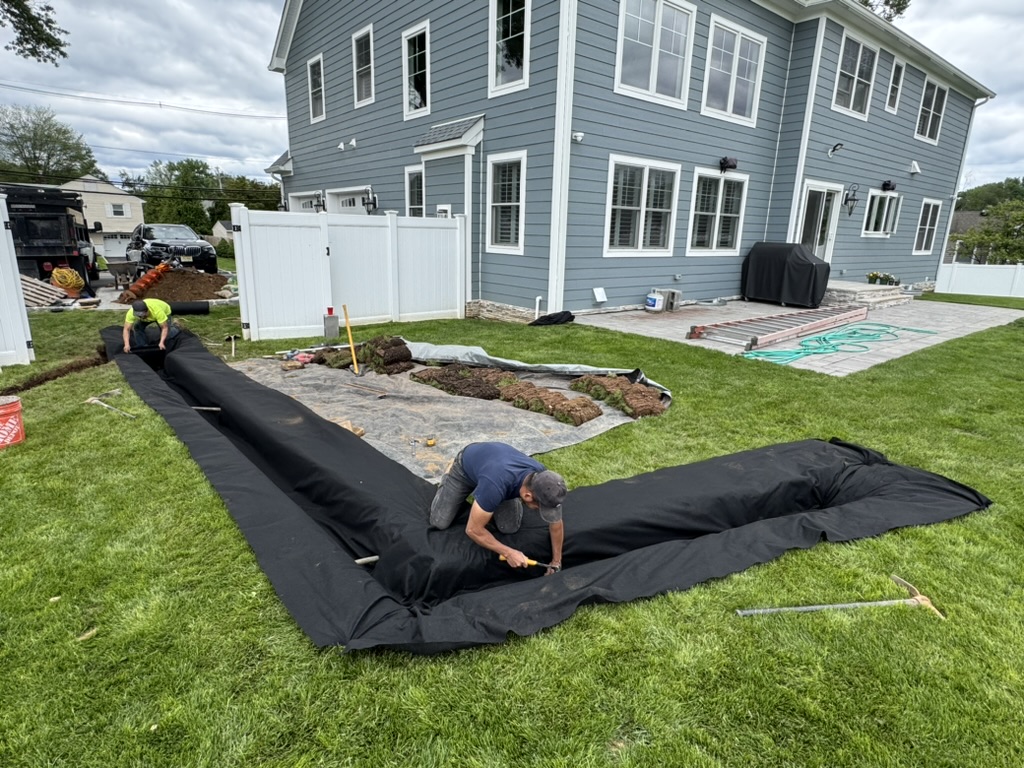
Here’s what the process actually involves. The crew excavates down to the footer, which, in a standard NJ home built to modern code, means going 8 to 10 feet deep along the affected wall. They clean the foundation surface, apply an elastomeric waterproofing membrane (not just damp-proofing, which is a much thinner, less durable coating — an important distinction), install a dimple board drainage mat over the membrane to protect it and channel water downward, and set a perforated footer drain at the base to carry water away from the structure.
The disruption is real. Your landscaping along that wall is gone. Patios, walkways, and plantings in the excavation zone have to be removed and rebuilt. On a typical NJ colonial, plan for 5–10 business days of active work and a full restoration period afterward.
The cost reflects that scope. Exterior waterproofing in NJ typically runs $15,000–$30,000+, depending on wall length, access difficulty, and soil conditions. It’s a significant investment — but on the right foundation, with the right symptoms, it’s the only permanent fix.
One important note on NJ code: exterior excavation work at residential depth requires compliance with OSHA trenching and shoring standards, and depending on your municipality, may require a permit through the NJ Department of Community Affairs (DCA). Any contractor who skips the permit conversation on an excavation job that deep is cutting a corner you don’t want cut.
Interior Waterproofing: When It’s the Smarter Solution
For the majority of NJ homeowners dealing with basement water problems, interior drainage is not a compromise — it’s the engineered solution specifically designed for their situation.
Here’s why. When water is entering through the cove joint or pushing up through the slab due to hydrostatic pressure, no exterior membrane addresses that problem directly. The water table around your home is under pressure, and that pressure is looking for the path of least resistance. An interior sub-floor drain system manages hydrostatic pressure by intercepting water at that point of entry, routing it through a perimeter channel beneath the slab, and directing it to a sump pit where a pump ejects it away from the home.

For cinder block or stone foundations — which are extremely common in Essex, Morris, and Passaic County homes built before 1970 — interior management is often the only practical option. Exterior membranes don’t bond reliably to irregular stone surfaces, and hollow cinder block cores can hold and transmit water in ways that no single exterior coating can fully address.
The sump pump setup matters as much as the drain system itself. A quality installation includes a primary pump and a battery backup — because the storms that cause your basement to flood are exactly the storms most likely to knock out your power. This isn’t an upsell; it’s basic redundancy engineering.
Interior work is significantly less disruptive. Most installations are completed in one to two days. Your landscaping is untouched. The finished work is clean, with a narrow channel along the perimeter and a sump basin that can be covered and integrated into your floor plan.
Cost for a full interior system in NJ typically runs $5,000–$12,000, depending on linear footage, foundation type, and sump configuration.
What About Radon? (An NJ-Specific Consideration)
New Jersey has elevated radon risk in many inland counties, and this is worth flagging because waterproofing and radon mitigation interact in ways most homeowners don’t expect.
A properly installed interior drainage system with full wall encapsulation can actually support radon mitigation by creating a more controlled sub-slab environment. However, if you’re planning radon mitigation and basement waterproofing simultaneously, the sequencing and system design need to be coordinated. The EPA’s radon guidance for homeowners is a solid starting point for understanding what’s required in your area before any sub-slab work begins.
The Honest Cost Comparison
Let’s put the numbers side by side so you’re walking into any estimate conversation with clear expectations.
| Interior System | Exterior Excavation | |
| Typical NJ Cost | $5,000 – $12,000 | $15,000 – $30,000+ |
| Project Duration | 1–2 days | 5–10+ days |
| Landscaping Impact | None | Significant |
| Finished Basement Impact | Minimal (narrow perimeter channel) | None (work is outside) |
| Best For | Cove joint/floor seepage, block/stone foundations, high water table | Wall face intrusion, poured concrete, membrane failure |
| Warranty | Lifetime transferable (reputable contractors) | Lifetime transferable (reputable contractors) |
| Permit Required? | Typically no | Often yes (NJ DCA) |
| Radon Interaction | Can support mitigation with proper design | Neutral |
Both systems, when properly installed by a qualified contractor, should carry a lifetime transferable warranty, which matters significantly for NJ home resale value. If a contractor isn’t offering that, keep asking questions.
How to Evaluate Any Contractor You Talk To
Before you sign anything, here’s what an honest, thorough assessment looks like:
- They walk the entire perimeter — inside and outside — before recommending anything.
- They identify the specific entry point(s) of your water intrusion, not just the general area.
- They explain why their recommended system addresses your specific symptom, using language you can follow.
- They discuss permit requirements if exterior work is involved.
- They give you a written quote that holds, even if the job gets more complex once work begins.
- They don’t push you toward a more expensive option if a less invasive solution solves the problem.
That last point is worth emphasizing. A contractor who recommends exterior excavation for a cove joint leak that an interior system would handle perfectly is either misinformed or overselling. And a contractor who recommends an interior drain for a foundation wall that’s actively failing structurally is doing you a disservice in the other direction. The right recommendation comes from the right diagnosis — full stop.
Conclusion: Match the Solution to the Problem
There’s no universal winner between interior and exterior basement waterproofing. The right answer lives at the intersection of your specific symptoms, your foundation type, and your New Jersey soil and groundwater conditions.
If water is pushing through the cove joint or up through the floor — especially in a block or stone foundation in Morris, Passaic, or Essex County — a properly designed interior drainage system with a redundant sump setup is almost certainly your most effective and least disruptive path forward.
If you have active wall-face intrusion on a poured concrete foundation, or visible membrane failure on an older exterior coating, excavation and re-waterproofing may be the only real fix.
The most important thing you can do right now is get a thorough, no-pressure assessment from a contractor who will walk your property, identify the source, and explain their reasoning — not just hand you a proposal.
ARD Waterproofing serves West Essex, Passaic, and Morris Counties. We’re a local, employee-owned company — every person on our crew has a personal stake in the quality of the work we leave behind. We’ll walk your property, show you exactly what we’re seeing, and give you a straight answer about which system makes sense for your home. No upsell. No pressure.
📞 Call or text us anytime — we’re available 24 hours. Military and first responder households receive a 12% discount.
Frequently Asked Questions
Is exterior waterproofing truly better than interior management for block foundations?
Not for most block foundation situations — and here’s the engineering reason why. Cinder block walls have hollow cores that can fill with water and transmit moisture through dozens of micro-entry points across the entire wall surface. An exterior membrane applied to the outside of that block can help reduce saturation, but it rarely creates a complete seal across an irregular, aging surface. Interior drainage systems are specifically designed to intercept water at the cove joint and relieve hydrostatic pressure from beneath the slab, which is where block foundation water problems typically originate. For most pre-1970 NJ homes with block construction, interior management is the more practical and effective long-term solution.
Do I need a construction permit for basement waterproofing in New Jersey?
It depends on the scope of work. Interior drainage systems — sub-floor channels, sump pump installation — typically do not require a permit in most NJ municipalities. Exterior excavation work is a different matter. Because it involves excavating to footing depth (8–10+ feet), it falls under OSHA trenching and shoring standards and may require a permit through your local building department under NJ Department of Community Affairs (DCA) guidelines. Always ask your contractor directly about permit requirements for your specific project, and be cautious of any contractor who dismisses the question of deep exterior work.
What is the cost difference between interior and exterior waterproofing in NJ?
Interior drainage systems in New Jersey typically range from $5,000 to $12,000, depending on the linear footage of the drain channel, foundation type, and sump pump configuration. Exterior excavation waterproofing generally runs $15,000 to $30,000 or more, reflecting the labor-intensive excavation, membrane application, drainage mat installation, and site restoration required. The higher cost of exterior work isn’t automatically a sign of a better outcome — it reflects the scope of the process. The correct system for your symptoms is the one that delivers a lasting result, regardless of which price point it falls at.
 Interior Perimeter Drainage System Installation NJ Guide