

Quick Answer: Six alternatives are worth considering: regrading, downspout extensions or buried leaders, a dry well, a surface channel drain, a swale or rain garden, and an interior perimeter system. Which one fits depends on where the water is coming from. Some of these cost a fraction of a French drain and solve the problem outright.
Homeowners usually arrive at this question for one of two reasons. Either a quote came back higher than expected, or the idea of a trench running through an established lawn is unappealing. Both are reasonable.
The thing most articles on this topic get wrong is treating alternatives as interchangeable products. They aren’t. A French drain does one specific job: it intercepts water moving through soil and gives it a low-resistance path somewhere else. Some alternatives do that same job differently. Others don’t do that job at all, and instead prevent the water from arriving, which is often better and cheaper.
So the useful way to approach this is backwards. Work out what your water is actually doing, then pick from the options that address it. A dry well installed for a problem that was really a grading problem is money spent on the wrong end of the system.
One honest note before the list. Correcting downspout discharge and grade resolves a meaningful share of the calls that start with “I think I need a French drain.” It’s the least profitable answer a drainage company can give, and it’s frequently the right one. Rule it in or out first.
📊 At a Glance
- Cheapest fix that often works: downspout extensions and grade correction, addressing water before it reaches the foundation
- Best for a soggy low spot with nowhere to drain: a dry well
- Best for water sheeting off a hard surface: a channel or trench drain
- Best when the yard has room and you want no pipe at all: a swale or rain garden
- Best when water is already inside: an interior perimeter system, which is an alternative to an exterior French drain
- What none of them do: replace a French drain’s specific job of intercepting subsurface water along a run
- Before any excavation in New Jersey: a One Call markout, minimum 3 full business days’ notice
First, work out what your water is doing
Four questions separate the options.
Where does the water show up? A wet spot in the middle of the lawn is a different problem from water at the foundation wall, which is different again from water pooling on a patio.
When does it show up? During rain points toward surface water. Hours after rain stops, or during a wet week with no single storm, points toward groundwater and a saturated soil profile.
Does it move or sit? Water that runs across the surface and collects wants to be intercepted or redirected. Water that appears from below and sits wants somewhere to go.
Where would it go if you gave it a path? This is the question that kills more drainage plans than any other. Every option below needs an outlet: a lower point on the property, a dry well, or a pump. On a flat lot with nowhere lower, the honest answer changes.
The six alternatives
1. Regrading and slope correction
Solves: water arriving at the foundation because the ground directs it there.
The soil around a foundation settles over the decades after backfill, and a grade that once sloped away can end up sloping back. Patios, walkways, and new landscaping beds all change how water moves. Correcting the slope so the first several feet fall away from the house is basic and effective.
Why consider it first: it’s usually the lowest cost item on this list, and it addresses the water before it becomes anyone’s drainage problem.
Limits: it does nothing for groundwater already in the soil profile, and it’s not always possible where a lot is tight, where a neighbor’s grade is higher, or where the house sits low.
2. Downspout extensions and buried leader lines
Solves: a roof’s worth of water being delivered to one spot at the corner of the foundation.
An average roof sheds a great deal of water in a heavy storm, and every bit of it exits through a handful of downspouts. A leader that ends at a splash block puts that volume directly into the soil against the wall. Extending the discharge well away from the house, or running a solid buried line to a better outlet, removes that load entirely.
Why consider it: it’s cheap, it’s fast, and it’s the most commonly overlooked fix in North Jersey.
Limits: the buried line needs a real outlet and needs to stay clear. Note that this is solid pipe carrying clean roof water, not perforated pipe, which is the opposite of a French drain.
3. Dry well
Solves: water you can collect but have nowhere to send.
A dry well is a buried chamber, usually a perforated tank or a stone-filled pit, that accepts water and lets it percolate into the surrounding soil over time. It’s a destination, not a collector, so it’s normally paired with something that gathers water first.
Why consider it: on a flat lot with no lower point, it may be the only outlet available short of a pump.
Limits: it depends entirely on how well the surrounding soil accepts water. In dense or clay-heavy soil it fills and stops accepting, which is why sizing and a percolation assessment matter. It also needs to sit well away from the foundation.
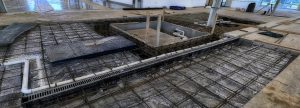
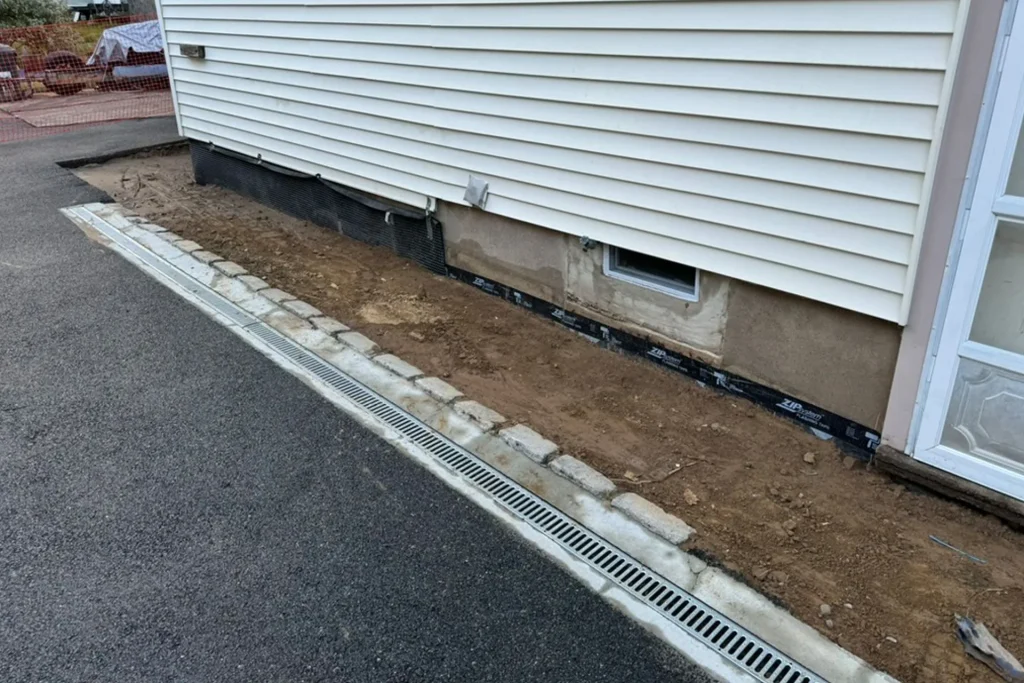
4. Channel drain or trench drain
Solves: surface water running off a hard surface, at the point where it leaves that surface.
A channel drain is a linear grated inlet set flush into concrete or pavers, typically at the base of a driveway, across a garage apron, or at the low edge of a patio. It catches sheet flow at the moment it becomes a problem and carries it away in solid pipe.
Why consider it: for a driveway that pitches toward the garage, nothing else does the job as directly.
Limits: it only handles water on the surface it’s set into. It does nothing for groundwater or for a wet lawn, and the grate needs cleaning.
5. Swale or rain garden
Solves: moving or absorbing surface water across an open yard with no pipe involved.
A swale is a shallow, shaped depression that guides surface water along a deliberate path. A rain garden is a planted low area designed to hold water briefly and let it soak in. Both are graded landscape features, not plumbing.
Why consider it: no pipe to clog, no pump to fail, and it can look like landscaping. On a property with the room, this is a durable answer.
Limits: it needs space and a workable route. It handles surface water only. And a swale that gets filled in later by a future owner or a new patio stops working silently.
6. Interior perimeter drainage system
Solves: water already entering the basement, when digging outside isn’t practical.
This is the alternative most relevant to homeowners who were quoted an exterior French drain. Instead of excavating around the outside of the foundation, the work happens inside: a channel cut in the slab at the perimeter, perforated pipe in stone, routed to a sump basin and pumped out.
Why consider it: it avoids excavating around a finished house, and around here that usually means it avoids the patio, the deck, the mature plantings, and the AC condenser. It also stays accessible for service, which an exterior membrane never is once backfilled.
Limits: it manages water after it has reached the foundation instead of before, it depends on a pump and therefore on power, and it requires breaking and repouring part of the slab.
Matching the symptom to the fix
| What you’re seeing | Look at first | Then consider |
|---|---|---|
| Water at the foundation during rain | Downspouts and grade | Interior perimeter system |
| Water at the foundation hours after rain stops | Interior perimeter system | Exterior footing drain |
| Soggy lawn, no outlet anywhere lower | Dry well | Swale or rain garden |
| Water running toward the garage or into a walkout | Channel drain | Regrading the approach |
| Standing water on a patio or hard surface | Channel drain | Repitching the surface |
| One persistent wet area on a slope | Swale | Curtain drain, which is a French drain variant |
| Water from a hillside above the house | Curtain drain or swale | Interior system as backup |
A note on curtain drains
A curtain drain gets described as an alternative and it isn’t really one. It’s a French drain positioned uphill of what you’re protecting, intercepting subsurface water before it reaches the structure. Same trench, same stone, same perforated pipe, different placement.
That’s worth knowing because if someone offers a curtain drain as a way to avoid a French drain, the two things are not different in kind.
What to ask before you decide
“What did you observe that points to this cause?” Any of these options can be sold. Only some of them fit your house, and the reasoning should be something you can follow.
“Where does the water end up?” Every option needs an outlet. Make sure yours has been identified and that it isn’t a neighbor’s property.
“What happens in a storm larger than the one this was sized for?”
“Has the downspout and grading question been ruled out?” If nobody looked, ask them to.
If you’re comparing an exterior French drain against an interior system, ask what the excavation would disturb and what it would cost to put back. That restoration line is frequently the difference between the two.
Frequently Asked Questions
What is the cheapest alternative to a French drain?
Correcting downspout discharge and grade is usually the least expensive option, and for surface water problems it can resolve the issue on its own. It’s worth ruling out before committing to excavation.
Can a dry well replace a French drain?
Not usually on its own. A dry well is a destination for water, not a collector, so it’s typically paired with something that gathers the water first. Its performance depends on how readily the surrounding soil absorbs water.
Is an interior drainage system better than an exterior French drain?
Neither is universally better. Exterior work addresses water before it reaches the wall, which is stronger engineering, but it means excavating around a finished house. Interior systems avoid that disruption and stay serviceable. The right choice depends on the property.
Do these alternatives need a permit in West Caldwell?
It depends on what the work connects to and how deep it goes. Work touching the building’s drainage piping generally requires a permit. Contact the West Caldwell Construction Department at 973-226-2302 to confirm for your project.
Do I still need to call 811 for these?
Yes, for anything involving excavation. New Jersey requires a markout before digging, with a minimum of 3 full business days’ notice, and it applies to homeowners as well as hired crews.
About ARD Waterproofing
ARD Waterproofing is a residential waterproofing company based at 98 Smull Ave in West Caldwell, New Jersey, serving West Essex, Passaic, and Morris counties.
The company installs interior and exterior French drains, sump pump systems, crawl space systems, and the grading and discharge corrections that often turn out to be the real fix.
Owner David Roth personally evaluates properties in West Caldwell, Livingston, and along the Bloomfield Avenue corridor before a job is priced. On a question about which drainage approach fits, that walkthrough is the whole answer, because the correct option depends on where your water is coming from.
To have a drainage problem assessed in West Caldwell, call (201) 646-5936.
This article is general information about residential drainage. It is not a diagnosis of any specific property. Site conditions, soil, and lot layout determine which approach is appropriate.
Sources
- N.J.S.A. 48:2-73 et seq., Underground Facility Protection Act
- New Jersey One Call, markout notice requirements
- N.J.A.C. 5:23, New Jersey Uniform Construction Code
- Township of West Caldwell, Construction Department
 Will Insurance Pay for Basement Waterproofing in West Caldwell, NJ?